
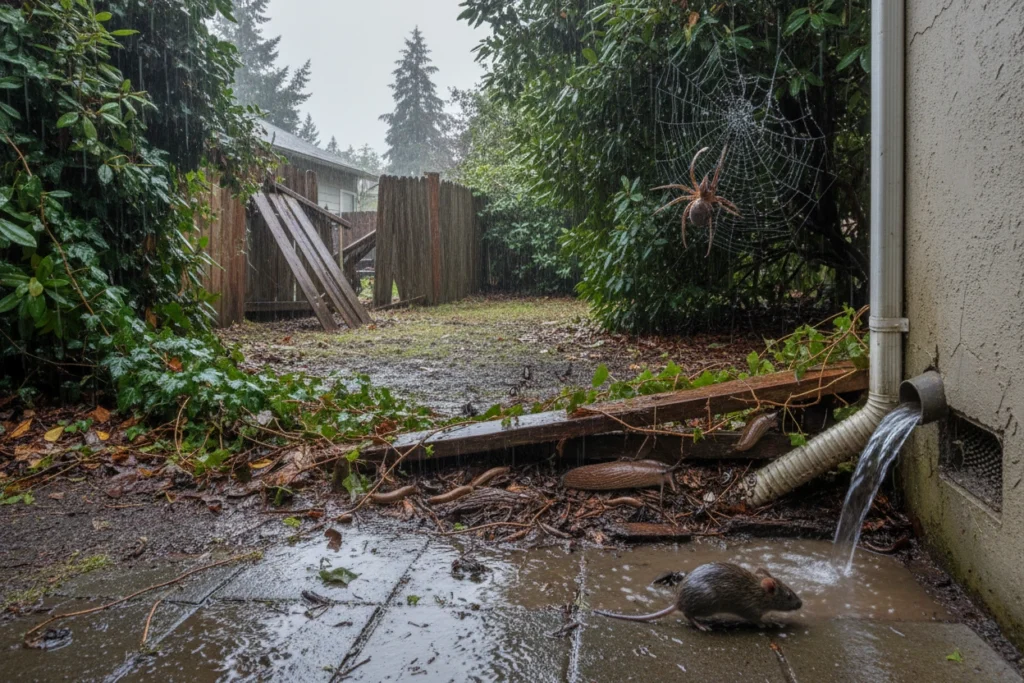
Tualatin’s wet winters push pests like rodents, ants, and cockroaches indoors as saturated soil destroys their outdoor harborage sites. Once inside, they establish nests and breed through every season. Moisture also accelerates wood rot in your home’s siding and framing, creating structural entry points that pests exploit year-round. Managing moisture, sealing gaps, and identifying pest species early are critical steps—and understanding exactly how each pest behaves gives you a significant advantage in stopping infestations before they escalate.
Key Takeaways
-
Wet winters saturate soil and displace pests, forcing rodents, ants, and insects to seek shelter, warmth, and food inside homes.
-
Excess moisture accelerates wood rot in siding and frames, creating structural entry points for carpenter ants and rodents.
-
Moisture-loving pests like earwigs, slugs, and fungus gnats persist long after rain, migrating deeper into structures where dampness remains.
-
During dry seasons, established rodent populations breed undisturbed while ants and spiders forage indoors, making pest pressure truly year-round.
-
Preventative measures like sealing entry points, fixing leaks, and seasonal inspections significantly reduce pest attraction and infestation risks.
Why Tualatin’s Wet Winters Drive Pests Indoors

Tualatin’s wet winters create ideal conditions for pests seeking shelter, warmth, and dry ground. As rainfall saturates the soil, it disrupts nesting sites, forces burrowing insects upward, and pushes rodents toward heated structures.
You’ll notice this pest behavior intensify between November and March, when sustained moisture eliminates outdoor harborage options.
Pests don’t wander indoors randomly—they follow moisture gradients, heat signatures, and food odors directly into your home. Gaps around pipes, deteriorating weatherstripping, and foundation cracks become primary entry points.
Once inside, they establish colonies quickly, making early detection critical. Implementing integrated pest management strategies during this time can significantly reduce the chance of infestations.
Understanding this seasonal pattern helps you act proactively rather than reactively. Recognizing your home as an indoor refuge for pests during wet months means you can implement targeted prevention strategies before infestations take hold.
Which Pests Are Most Active During Tualatin Winters?
When winter arrives in Tualatin, certain pests become considerably more problematic than others. Understanding pest behavior during colder months helps you anticipate and prevent infestations before they establish.
Rats and mice are the most active winter invaders. Their winter survival strategy centers on finding warmth, food, and shelter inside your home’s walls, attic, and crawl space.
Odorous house ants follow moisture trails indoors, particularly during heavy rain events.
Spiders move inside seeking prey and stable temperatures, often settling in undisturbed storage areas.
Cockroaches thrive in warm, humid spaces like kitchens and bathrooms year-round but intensify activity when outdoor conditions deteriorate.
Identifying which pest you’re dealing with determines the correct treatment approach, so accurate identification is your critical first step. Additionally, early identification of pest issues is crucial to effectively manage and prevent infestations.
How Moisture Damage Creates Year-Round Entry Points
Tualatin’s wet climate accelerates wood rot in siding, fascia boards, and window frames, turning softened wood into easy access points for carpenter ants, rodents, and other pests.
When materials like door frames and foundation components absorb moisture, they swell and shift, creating gaps that remain even after they dry out.
You should inspect these areas seasonally, because compromised wood and persistent gaps don’t seal themselves and will continue inviting pest activity throughout the year. Additionally, vulnerable areas around doors and windows should be monitored closely for signs of deterioration.
Wood Rot Invites Pests
Moisture damage doesn’t just weaken your home’s structure—it actively signals pests that there’s an easy way in.
Wood decay accelerates in Tualatin’s wet winters, softening fascia boards, window frames, sills, and structural beams. Once wood softens, it becomes both an entry point and a food source.
Carpenter ants don’t excavate healthy wood—they target decayed material. Rats and mice gnaw through compromised wood far more easily than solid lumber. Termites follow moisture gradients directly to rotting wood, establishing colonies before you notice visible damage.
The pest attraction cycle works like this: moisture weakens wood, wood decays, pests exploit the weakness, and their activity accelerates further deterioration.
Inspect your eaves, crawl space framing, and deck ledgers annually. Replacing rotted wood eliminates both the structural vulnerability and the invitation.
Gaps From Swelling Materials
Repeated exposure to rain and humidity causes wood, concrete, and composite materials to expand and contract seasonally, creating gaps that didn’t exist when your home was built.
These shifts separate door frames, foundation joints, siding seams, and utility penetrations—opening direct entry points for rodents, ants, and other pests.
Material swelling doesn’t reverse cleanly. Each cycle leaves slightly more separation than before, progressively worsening structural vulnerabilities.
A professional gaps assessment identifies these points systematically, measuring separations at thresholds, pipe entries, window frames, and crawl space vents.
Once documented, you can address each gap with appropriate materials—expanding foam, weatherstripping, caulk, or hardware cloth—matched to the specific material and location.
Sealing these entry points eliminates access before pests establish interior harborage.
The Pests That Stick Around After the Rain Stops
When the rain stops, moisture-loving pests like slugs, earwigs, and fungus gnats don’t disappear—they retreat into the damp soil, mulch, and wood debris surrounding your home.
As conditions dry out, other pests like ants, spiders, and rodents shift their activity, moving indoors to find the water and shelter they can no longer source outside.
You’re fundamentally dealing with two overlapping pest pressures: species that thrive in wet conditions and species that respond to dry ones. Additionally, as pests seek shelter indoors, it’s crucial to seal gaps around foundations and windows to block entry points.
Moisture-Loving Pests Persist
Heavy rainfall doesn’t just invite pests in—it conditions your property to keep them there long after the skies clear. Understanding pest habits helps explain why. Slugs, sowbugs, earwigs, and fungus gnats don’t retreat when conditions dry out—they migrate deeper into your home’s structure where residual moisture persists in crawl spaces, wall voids, and under slabs.
Effective moisture management is your first line of defense. Address standing water, fix leaking pipes, improve subfloor ventilation, and seal entry points where damp exterior wood meets your foundation.
Without these steps, your home stays hospitable to pests regardless of outdoor conditions.
Pest Patrol identifies moisture-driven infestations at their source and implements targeted treatments that eliminate existing populations while correcting the conditions that allowed them to establish.
Dry Season Pest Activity
As summer arrives and rainfall tapers off in Tualatin, pest pressure doesn’t diminish—it shifts.
Dry season conditions drive pest behavior in predictable ways. Ants forage aggressively for water, infiltrating kitchens and bathrooms. Spiders follow their prey indoors as insects seek cooler, moisture-retaining environments.
Rodents, already established in wall voids and crawl spaces from winter, continue breeding through summer undisturbed.
You’re now dealing with populations that built up over wet months and adapted to your structure. Without intervention, these pests won’t self-correct when temperatures drop again—they’ll simply revert back into a winter survival cycle inside your home.
Addressing dry season pest behavior requires targeted treatments at entry points, harborage zones, and food or water sources before populations reach their seasonal peak.
What Tualatin Homeowners Can Do to Prevent Infestations
Preventing infestations starts with eliminating the conditions that attract pests in the first place. These practical homeowner tips and preventative measures reduce your exposure considerably:
-
Seal entry points — Caulk gaps around pipes, windows, and foundation cracks where moisture and pests enter together.
-
Manage moisture — Fix leaky gutters, improve drainage, and ventilate crawl spaces to eliminate the damp conditions pests thrive in.
-
Eliminate food sources — Store food in airtight containers, clean up debris, and secure garbage bins.
-
Trim vegetation — Keep shrubs, trees, and ground cover away from your home’s exterior.
-
Inspect regularly — Check attics, crawl spaces, and basements seasonally for early signs of activity.
Consistent maintenance removes the invitation pests need to move in. Additionally, implementing Integrated Pest Management (IPM) can enhance your efforts by providing a comprehensive approach to pest control.
When to Call a Pest Control Professional in Tualatin
Sometimes the line between a manageable nuisance and a full-blown infestation isn’t obvious until the problem has already escalated. If you’re seeing repeated activity despite DIY efforts, it’s time to call a professional.
Pest identification techniques matter here — misidentifying a species means applying the wrong treatment, which wastes time and allows colonies to grow.
Watch for these specific triggers: structural damage, droppings in multiple locations, nests inside walls or attics, or pests appearing outside their typical seasonal pest trends. Any of these signals a deeper issue requiring professional assessment. Early detection is crucial, as it can prevent infestations from spiraling out of control.
Pest Patrol serves Tualatin with targeted inspections and treatments designed for the Pacific Northwest climate.
Don’t wait for visible damage to confirm what early intervention could’ve prevented. Contact Pest Patrol to schedule an inspection.
Frequently Asked Questions
Does Pest Patrol Offer Free Inspections for Tualatin Homeowners?
Pest Patrol offers free inspections, giving you free inspection benefits and homeowner peace. You’ll get a thorough assessment identifying active infestations, entry points, and moisture-driven vulnerabilities, so you can implement targeted, effective pest management solutions confidently.
Are Pest Patrol’s Treatments Safe for Children and Pets?
Yes, Pest Patrol’s treatments prioritize child safety and pet safety. They use proven, targeted solutions that protect your family while effectively eliminating pests. You can trust their methodical approach delivers results without compromising your household’s well-being.
How Much Does Pest Control Service Typically Cost in Tualatin?
You’ll find average costs vary based on pest type and treatment scope. For accurate service comparisons, contact Pest Patrol directly—they’ll assess your Tualatin property and provide transparent, upfront pricing tailored to your specific situation.
Does Pest Patrol Offer a Satisfaction Guarantee on Their Services?
Yes, Pest Patrol backs their service reliability with a 100% satisfaction guarantee. If you’re not happy, they’ll act on your customer feedback and make it right, ensuring you receive effective, dependable pest control results.
How Quickly Can Pest Patrol Respond to a Pest Emergency?
Pest Patrol’s fast emergency response gets a technician to you quickly. They’ll handle precise pest identification and deploy targeted treatments efficiently, so you’re not waiting long when a pest problem demands immediate, professional attention.
Conclusion
Tualatin’s wet winters don’t just bring mud and gray skies — they create the exact conditions pests need to invade your home. Once they’re in, they don’t leave on their own. You’ll need a proactive, year-round strategy that addresses moisture control, structural entry points, and seasonal pest behavior. Don’t wait until you’re dealing with a full infestation. Take preventative steps now, and if you’re already seeing signs, contact a licensed Tualatin pest control professional immediately.