

Before you bring your real Christmas tree indoors, you’ll want to inspect it carefully for hitchhiking arthropods. Common stowaways include adelgids, bark beetles, psocids, mites, aphids, and orb-weaving spiders—each occupying distinct microhabitats across bark, needle clusters, and branch axils. Position the tree upright in bright light, shake it over a white tarp, and examine dislodged material for movement. Early taxonomic identification of any specimens you find makes removal far more targeted and effective—and there’s much more you can do to protect your home.
Key Takeaways
-
Shake the tree vigorously over a light-colored tarp outdoors to dislodge hidden insects, mites, and adelgids before bringing it inside.
-
Use a flashlight and magnifying glass to inspect bark, branch axils, and needle clusters for egg masses or webbing.
-
Common hitchhiking pests include spiders, bark beetles, psocids, adelgids, and mites hiding within dense foliage and bark.
-
Avoid aerosol pesticide sprays indoors; instead, vacuum visible insects carefully or consult a licensed pest management professional.
-
Treat the tree with insecticidal soap before entry, and regularly inspect it throughout the entire holiday season.
Which Bugs Actually Hide in Christmas Trees?
Several insect and arachnid species commonly hitchhike into homes on fresh-cut Christmas trees, most of them specific to coniferous hosts. When you bring a live tree indoors, you’re potentially introducing tree pests from multiple taxonomic orders.
Adelgids (Hemiptera: Adelgidae) colonize needles and branches, while bark beetles (Coleoptera: Scolytinae) tunnel beneath the bark. Psocids, or bark lice, feed on mold and organic debris between branches. Spiders and their egg sacs — particularly orb-weavers — shelter within dense foliage. Mites, including Cinara species aphids, round out the most frequently encountered arthropods.
These aren’t random seasonal infestations. Each species exploits the tree’s specific microhabitat. Warming the tree indoors accelerates egg hatching and increases activity, rapidly turning a dormant population into a visible, spreading one. Understanding the scope of pest problems can help you identify and manage potential infestations before they escalate.
How to Inspect Your Tree Before It Comes Inside
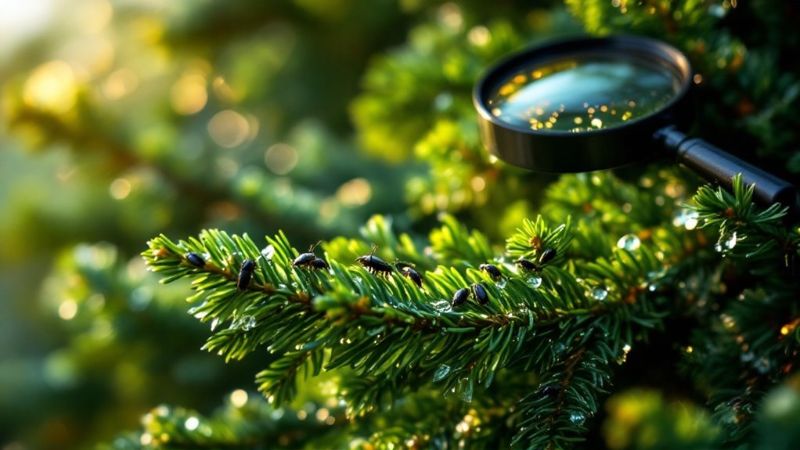
Before bringing your tree indoors, position it upright in a well-lit area and systematically examine the bark, branch axils, and needle clusters for egg masses, webbing, or live arthropods.
Use a flashlight to inspect the lower trunk and interior branches, where adelgids, scale insects, and mite colonies tend to concentrate.
Vigorously shake the tree over a light-colored tarp or sheet, then examine any dislodged material for movement to identify mobile pest species before they enter your home.
Visual Inspection Techniques
Taking a few minutes to visually inspect your Christmas tree before bringing it inside can prevent a surprising number of arthropod species from entering your home.
Use a flashlight and magnifying glass as your primary inspection tools, scanning methodically from the base to the crown. Examine bark crevices, needle clusters, and branch axils — microhabitats where overwintering tree pests concentrate.
Look for egg masses, silk webbing, and dark speckling consistent with mite or scale infestations. Pay particular attention to the trunk’s lower sections, where bark beetles and wood-boring insects commonly deposit eggs.
Inspect both the dorsal and ventral surfaces of branch clusters. Any discovered insects, egg cases, or unusual plant material should be documented and the affected branches removed before entry.
Shaking Out Hidden Pests
Mechanical agitation is one of the most effective pre-entry screening methods for dislodging cryptic arthropods from cut conifers.
Before bringing your tree inside, grasp the trunk firmly and shake it vigorously over a light-colored tarp or drop cloth. This motion displaces dormant Cinara aphids, adelgids, bark lice (Psocoptera), and spider mite egg masses clinging to interior branch architecture.
Repeat the process two to three times, rotating the tree to expose different radial sections. Examine the collected debris under magnification if possible, distinguishing between inert organic matter and motile invertebrates. Consistent tree care at this stage greatly improves pest prevention outcomes.
Many insects remain in diapause and appear lifeless, so don’t assume stillness equals absence. Dispose of collected debris away from your home’s foundation immediately.
The Shake-It-Out Method (And Why It Works)
Shake your tree vigorously before bringing it indoors — this remains one of the most effective mechanical methods for dislodging insects and other arthropods from the branches.
Mechanical agitation disrupts the grip of invertebrates across multiple taxonomic groups, making it a reliable first-line bug prevention strategy against common tree pests.
Shaking works effectively against:
-
Mites (Acari): Dislodges overwintering eggs and mobile nymphs clustered near bark and needle bases
-
Aphids (Aphididae): Removes dormant colonies concealed within branch crevices and bud axils
-
Adelgids (Adelgidae): Detaches waxy egg sacs adhered to needle undersides
Perform the shaking outdoors, rotating the tree through multiple axes to maximize arthropod removal.
Many retail tree lots provide mechanical tree shakers — use them when available for more thorough results. Additionally, ensuring proper hygiene and sanitation in your home can further reduce the risk of pest infestations.
Safe Ways to Treat a Tree Without Ruining It
Once you’ve shaken out the tree, you can reinforce pest removal with targeted treatments that won’t compromise the tree’s structural integrity or flammability rating.
For tree care, apply diatomaceous earth sparingly to the trunk and lower branches—it dehydrates arthropods through cuticular desiccation without introducing toxins indoors. Natural repellents like diluted neem oil (azadirachtin-based formulations) disrupt insect molting cycles and deter re-infestation. Additionally, using eco-friendly practices ensures a safer home environment for your family and pets.
Avoid aerosol pesticides entirely; most are flammable and incompatible with indoor use near heat sources. A brief cold-temperature quarantine—leaving the tree in an unheated garage for 24–48 hours—immobilizes cold-sensitive species before you bring it inside.
Never use water-based sprays excessively, as moisture accelerates needle drop and encourages fungal proliferation on cut conifer tissue.
What to Do If You Find Bugs After Setup
Discovering live arthropods after your tree is fully decorated requires immediate, targeted action to prevent indoor establishment.
Don’t panic—most conifer-associated species won’t survive long indoors—but you’ll want to act fast using targeted bug identification tips and pest prevention strategies.
-
Vacuum carefully: Use a hose attachment to extract visible specimens from branches, bark crevices, and needle clusters without disturbing decorations.
-
Isolate infested sections: Identify which taxonomic group you’re dealing with—Hemiptera, Psocoptera, Acari—before applying any intervention.
-
Avoid aerosol sprays indoors: Chemical applications near decorative lighting create fire and toxicity hazards.
If populations persist or you identify species like Cinara aphids or bark beetle larvae, contact a licensed pest management professional for accurate species-level identification and targeted treatment protocols. Additionally, implementing preventive measures can help reduce the likelihood of future infestations.
When to Call a Pest Control Professional
Accurate pest identification is critical before selecting treatment options, as misidentification leads to ineffective or unnecessarily broad chemical application.
A trained technician can distinguish transient, non-establishing arthropods from reproductively viable indoor populations, preventing unnecessary treatment or, conversely, underestimating a genuine infestation. Additionally, using natural deterrents can help reduce the chances of pests returning after treatment.
Portland-area residents experiencing post-Christmas-tree pest activity can contact Pest Patrol for professional assessment.
Early intervention limits population establishment and reduces the scope—and cost—of required remediation.
Frequently Asked Questions
Can Christmas Tree Bugs Survive and Spread to Other Areas of My Home?
Yes, they can. Hitchhiking arthropods you’ve introduced can establish indoor populations, threatening your home. Prioritize tree pest identification before entry and practice indoor bug prevention by inspecting and quarantining your tree outdoors first.
How Long After Setup Do Most Hidden Tree Bugs Typically Emerge?
Most tree bug emergence occurs within 1–2 weeks of indoor setup. As your home’s warmth accelerates pest lifecycle development, dormant eggs and overwintering insects detect the temperature shift, triggering premature emergence well ahead of their natural spring cycle.
Are Certain Christmas Tree Species More Prone to Harboring Pests Than Others?
Yes, tree species vary in pest resistance. You’ll find Douglas fir (Pseudotsuga menziesii) and noble fir (Abies procera) harbor more adelgids and mites, while Scotch pine (Pinus sylvestris) frequently hosts scale insects and bark beetles.
Can Bugs From a Christmas Tree Infest My Existing Houseplants?
Yes, tree-dwelling arthropods can migrate to your houseplants. Aphids, spider mites, and scale insects—once introduced—threaten plant health rapidly. Conduct thorough pest identification on both your tree and existing plants to prevent cross-infestation.
Do Christmas Tree Farms in the Portland Area Treat Trees for Pests?
Practices vary by farm—you can’t assume uniform tree farm treatments. Contact local Portland-area farms directly to inquire about their pest management practices, as some apply pesticides while others rely on integrated biological controls.
Conclusion
Bringing a live Abies, Picea, or Pseudotsuga specimen indoors introduces a microhabitat populated by arthropod species including Cinara aphids, Phytophthora adelgids, and Tetranychus mites. You can considerably reduce infestation risk by mechanically agitating the tree, inspecting branch nodes, and avoiding aerosol pesticides near foliage. If you’ve discovered an established population post-installation, you’ll need professional intervention. Don’t let dormant pest species disrupt your household ecosystem — act systematically before your tree crosses the threshold.