
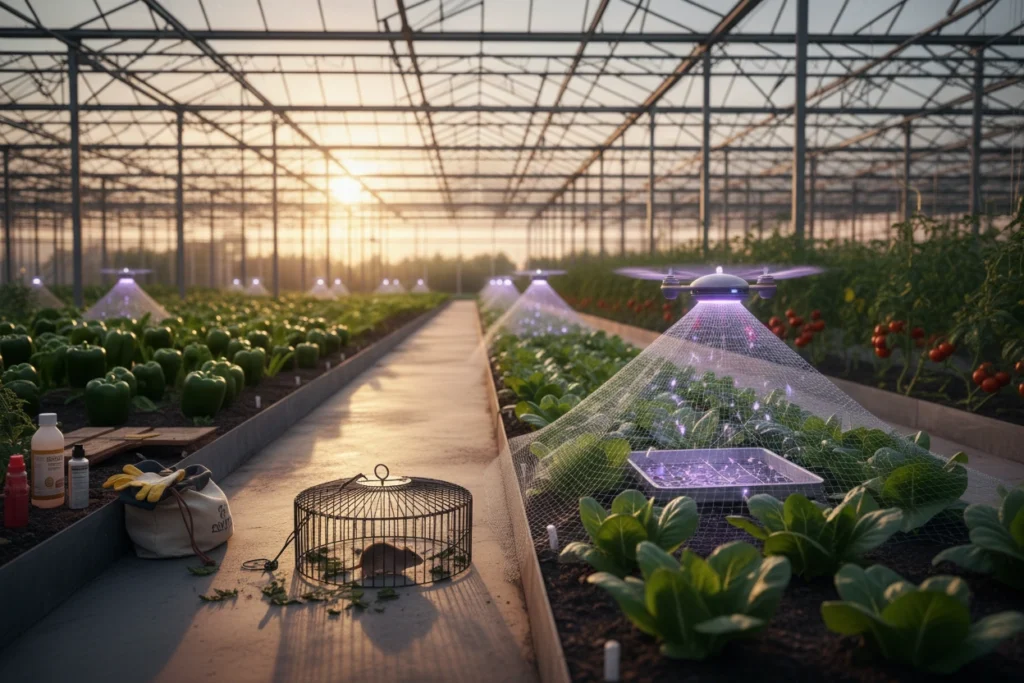
Effective greenhouse pest management requires you to combine physical exclusion, biological controls, and consistent monitoring. Seal structural gaps with weatherstripping or caulk, install 50–80 mesh screens on ventilation points, and inspect leaf undersides and soil surfaces daily. Deploy beneficial insects like Phytoseiulus persimilis and microbial treatments such as Bacillus thuringiensis to suppress populations before they escalate. Aphid colonies double every 4–5 days, making early intervention critical. The strategies ahead will sharpen your entire approach.
Key Takeaways
-
Identify pests early using sticky traps, inspecting leaf undersides, and tracking frass or gnaw marks to enable timely intervention.
-
Seal gaps in glazing panels, door seals, and ventilation openings to block rodent and insect entry points.
-
Install fine mesh screens (50-80 mesh per inch) over openings to exclude insects while maintaining adequate airflow.
-
Use integrated pest management, combining beneficial insects, microbial pesticides, and insecticidal soaps to control infestations effectively.
-
Remove dead plant material, fix leaks, and eliminate standing water to reduce conditions that attract and sustain pests.
Common Greenhouse Pests: Insects and Rodents to Watch For

Greenhouses create ideal conditions for plant growth—but those same warm, humid environments attract a range of damaging pests.
You’ll commonly encounter aphids, whiteflies, fungus gnats, spider mites, and thrips among insects, while rodents like mice and rats exploit structural gaps to access warmth and food sources. Each species causes distinct damage patterns, making accurate pest identification techniques essential before selecting any treatment. Misidentifying a pest wastes time and resources while infestations worsen.
Rodents chew irrigation lines and contaminate growing media, while insects compromise plant tissue and transmit pathogens. To effectively manage these pests, it is crucial to implement professional solutions tailored to your specific greenhouse environment.
Monitoring sticky traps, inspecting leaf undersides, and tracking frass or gnaw marks systematically helps you build an accurate picture of what you’re dealing with—a necessary foundation before applying organic pest solutions or other targeted interventions.
How Pests Get Into Your Greenhouse (And Why It Matters)
Pests enter your greenhouse through gaps in glazing panels, damaged door seals, ventilation openings, and on infested plant material you introduce yourself. Once inside, they’re drawn to warmth, humidity, standing water, decaying organic matter, and the dense plant canopy that provides both food and shelter. Left unchecked, even a minor infestation can devastate crops, spread plant pathogens, and compromise the controlled environment your greenhouse depends on. Implementing measures to seal gaps and holes in your greenhouse is crucial for preventing pest entry and protecting your harvest.
Common Greenhouse Entry Points
Even a well-maintained greenhouse has structural vulnerabilities that pests exploit to gain entry. Gaps around greenhouse ventilation systems represent one of the most frequently overlooked access points, allowing insects and small rodents to move freely between exterior environments and your growing space.
Other common entry points include:
-
Damaged door seals and thresholds
-
Cracked glazing panels or frame joints
-
Unscreened roof vents and louvers
-
Utility penetrations (irrigation lines, electrical conduits)
-
Soil and growing media introductions
Systematic pest monitoring helps you correlate infestation patterns with specific structural deficiencies. Document where you first observe pest activity—this data consistently points back to discrete entry locations.
Addressing these vulnerabilities through physical exclusion is your most cost-effective, long-term pest management strategy before chemical or biological interventions become necessary.
Pest Attractants Inside Greenhouses
While structural vulnerabilities determine how pests enter your greenhouse, internal conditions determine why they stay. Decomposing organic matter, standing water, and overripe fruit emit volatile compounds that attract both insects and rodents.
Poor humidity control creates persistently moist microclimates ideal for fungus gnats, shore flies, and mold-feeding mites.
Your plant selection also influences pest pressure greatly. Dense, broad-leafed species provide shelter and oviposition sites, while stressed or overcrowded plants emit distress signals detectable by aphids and whiteflies.
Research confirms that aphids orient toward yellowing foliage through olfactory cues.
Nutritional gradients matter too. High-nitrogen fertilization produces soft, nitrogen-rich plant tissue that accelerates insect reproduction rates.
Identifying and eliminating these internal attractants reduces infestation risk more effectively than reactive treatments alone.
Risks Of Unchecked Infestations
Unchecked greenhouse infestations follow predictable escalation patterns that compound biological, economic, and structural damage over time. Understanding pest population dynamics helps you anticipate how quickly manageable problems become catastrophic ones.
A single aphid colony doubles every four to five days under ideal greenhouse conditions. Rodents reproduce faster when food sources remain stable and shelter is undisturbed.
Infestation consequences extend beyond crop loss. Rodents gnaw irrigation lines, electrical wiring, and structural supports, creating secondary hazards. Fungal pathogens colonize honeydew deposits left by sucking insects, compounding plant stress.
Pest pressure also weakens root systems, reducing nutrient uptake and yield quality.
Early intervention consistently produces better outcomes than reactive treatment. You’ll spend considerably less time, money, and resources addressing infestations before populations establish and diversify across your greenhouse environment.
Physical Barriers That Keep Rodents and Insects Out
Physical barriers represent your first and most reliable line of defense against greenhouse pest intrusion.
You can install fine mesh screens—typically 50 to 80 mesh per inch—over vents, doors, and openings to exclude insects while maintaining adequate airflow.
Seal structural gaps, cracks along foundation joints, and door frames with weatherstripping or caulk to deny rodents access, since mice can squeeze through openings as small as 6 millimeters. Additionally, ensuring that stored pet food and bird seed is kept in airtight containers can significantly reduce the attraction for nearby rodents.
Mesh Screens and Netting
Mesh screens and netting serve as two of the most reliable first-line physical barriers for excluding rodents and insects from greenhouse environments.
When evaluating netting materials comparison, you’ll find that fiberglass, aluminum, and polyethylene each offer distinct trade-offs in durability, UV resistance, and mesh aperture size. For insect exclusion, select mesh with openings no larger than 0.6mm; for rodents, use 6mm galvanized hardware cloth.
Mesh installation techniques matter greatly—secure edges with compression fittings or staple channels to eliminate gaps exceeding 6mm, which rodents actively exploit. Overlap seams by at least 50mm and inspect seals quarterly for wear.
Prioritize rigid frames over flexible alternatives at entry points, as rodents readily push through unsupported netting under sustained pressure.
Sealing Entry Points
Even the most robust mesh installation loses effectiveness if gaps elsewhere in the greenhouse structure remain unsealed.
You’ll need to audit your structure systematically, examining foundation joints, ventilation collars, utility penetrations, and door frames. Research confirms rodents exploit openings as small as 6mm, while many insects require considerably less.
Your choice of entry point materials matters greatly. Use silicone or polyurethane caulk for static cracks, galvanized hardware cloth for larger voids, and expanding foam with pest-deterrent additives for irregular cavities.
Apply sealing techniques methodically — work from the foundation upward, ensuring each layer overlaps the previous by at least 25mm.
Re-inspect sealed points seasonally, as thermal expansion and material degradation routinely reopen vulnerabilities that pests will quickly exploit.
Safe Chemical and Biological Controls for Greenhouse Pests
When physical barriers alone aren’t enough, chemical and biological controls offer targeted, evidence-based solutions for managing greenhouse pests.
Integrated pest management combines natural repellents, beneficial organisms, and selective pesticides to reduce chemical load while maintaining efficacy.
Three proven control methods include:
-
Beneficial insects – Release predatory species like Phytoseiulus persimilis to suppress spider mite populations without chemical intervention.
-
Microbial pesticides – Apply Bacillus thuringiensis (Bt) to target caterpillars and fungus gnats with minimal non-target impact.
-
Insecticidal soaps and neem oil – Use these natural repellents as contact treatments against aphids, whiteflies, and thrips while preserving beneficial insect populations.
Always rotate control methods to prevent resistance development and document application rates to refine your integrated pest management strategy over time. Additionally, implementing proactive pest prevention strategies can significantly enhance the effectiveness of these methods.
Daily Habits That Prevent Greenhouse Pest Problems
While chemical and biological controls address active infestations, consistent daily practices reduce the conditions that allow pest populations to establish in the first place.
You should integrate routine inspections into your daily workflow, examining leaf undersides, soil surfaces, and structural entry points each morning. Early pest identification allows you to intervene before populations reach economically damaging thresholds.
Remove dead plant material promptly, as decaying organic matter attracts fungus gnats, shore flies, and rodents.
Control moisture by fixing leaks and improving drainage, since humid microclimates accelerate pest reproduction.
Sanitize tools between plant zones to prevent passive transport of eggs and larvae.
Log your findings systematically—recorded data reveals infestation patterns, helping you anticipate and prevent recurring pest pressure throughout the growing season. Additionally, implementing regular pest control can significantly enhance your efforts in maintaining a pest-free environment.
When to Call a Professional Pest Control Service
Despite consistent preventive practices, some infestations exceed the scope of DIY management and require professional intervention.
Accurate pest identification methods are critical at this stage, as misidentification leads to ineffective treatments and prolonged crop damage.
Professional consultation benefits include targeted chemical application, species-specific removal strategies, and long-term prevention planning backed by field expertise.
Contact a professional pest control service when you encounter:
-
Recurring infestations that persist despite multiple treatment cycles, indicating an unresolved entry point or breeding site.
-
Unidentified pest species causing structural or crop damage without a clear source.
-
Rodent activity, including droppings, gnaw marks, or nesting materials, which signals a population requiring systematic elimination.
Pest Patrol serves the Portland metro area and delivers evidence-based pest management solutions for residential and commercial properties.
Frequently Asked Questions
Can Greenhouse Pests Spread to My Home or Garden Nearby?
Yes, greenhouse pests can migrate to your home or garden. You’ll face potential home infestations without proper insect barriers and rodent prevention strategies. Pest migration follows food, warmth, and shelter cues, making nearby structures vulnerable targets.
How Do I Safely Dispose of Pest-Damaged Plants or Produce?
Bag and seal pest-damaged produce before disposal—don’t add it to composting methods, as it can spread pathogens. Heavily contaminated material may qualify as hazardous waste; check Portland’s local disposal guidelines for safe, evidence-based handling protocols.
Does Greenhouse Size Affect What Types of Pests You Attract?
Yes, your greenhouse’s size directly influences pest diversity. Larger structures attract more varied species due to increased microclimates, while smaller ones allow better space efficiency, making monitoring and targeted treatments more manageable and scientifically controlled.
Are Certain Greenhouse Materials More Resistant to Rodent Damage?
Yes, your greenhouse design choices matter. Polycarbonate panels and metal framing are the most effective rodent proof materials—they’re far harder to gnaw through than wood or standard plastic, markedly reducing your vulnerability to rodent entry.
How Does Portland’s Climate Influence Greenhouse Pest Activity Year-Round?
Portland’s mild, wet winters sustain pest populations year-round. You’ll face elevated humidity levels that accelerate fungus gnat and mold mite activity, while temperature fluctuations between seasons trigger rodent intrusions as they’re seeking warmth inside your greenhouse.
Conclusion
You’ve now got the evidence-based tools to defend your greenhouse systematically. By combining physical barriers, biological controls, and consistent monitoring protocols, you’ll greatly reduce pest pressure before infestations establish. Don’t wait for visible damage to act—early intervention data consistently shows better outcomes than reactive treatments. Implement these layered strategies methodically, track your results, and you’ll maintain a productive, pest-resistant growing environment throughout every season.