

When pests invade your home, they leave behind biological residues — shed exoskeletons, fecal matter, urine proteins, and decomposed body parts — that become airborne contaminants. These particles contain foreign antigens that sensitize your IgE antibodies, triggering mast cell degranulation, histamine release, and chronic airway inflammation. Over time, repeated exposure can develop into asthma or hypersensitivity pneumonitis. Understanding exactly which pests, surfaces, and testing methods are involved gives you a precise framework for protecting your air quality.
Key Takeaways
-
Cockroaches, rodents, and dust mites release allergens through droppings, dander, and shed skin, directly contaminating indoor air.
-
Pest byproducts contain foreign proteins that trigger IgE antibody sensitization, causing allergic reactions and chronic airway inflammation.
-
Allergens accumulate in kitchens, bedrooms, bathrooms, and basements, making targeted cleaning in these areas essential.
-
Standard air quality tests miss pest allergens; specialized ELISA-based assays and PCR testing accurately detect contamination levels.
-
Restoring air quality requires HEPA purifiers, deep cleaning, sealed entry points, and upgraded MERV-13 HVAC filters.
The Pests Most Responsible for Poor Indoor Air Quality
Several pests are known contributors to degraded indoor air quality, with cockroaches, rodents, and dust mites ranking as the most impactful.
Understanding pest behavior helps you identify how each species introduces allergens into your environment. Cockroaches shed exoskeletons and deposit fecal matter, both notable allergen sources linked to asthma triggers.
Rodents release allergenic proteins through urine, dander, and saliva, which dry and become airborne.
Dust mites thrive in bedding and upholstery, producing waste particles that circulate through your HVAC system.
Each pest’s biological activity directly degrades air quality through distinct contamination pathways.
You’ll find that early identification of these species, combined with targeted remediation, considerably reduces airborne allergen concentrations and minimizes associated respiratory health risks within your living or working space.
What Pest Byproducts Actually Do to Your Lungs and Immune System
When pest byproducts enter your respiratory tract, they trigger a cascade of immunological and physiological responses that can cause lasting damage. Pest droppings contain proteolytic enzymes and fecal proteins that your immune system identifies as foreign antigens.
Repeated allergen exposure sensitizes your IgE antibodies, making subsequent exposures progressively more reactive. This sensitization drives mast cell degranulation, releasing histamine and inflammatory cytokines that inflame your bronchial tissue.
Your lungs respond to this chronic inflammation by narrowing airways, increasing mucus production, and reducing alveolar efficiency. Over time, these respiratory issues can develop into occupant-diagnosed asthma or hypersensitivity pneumonitis.
Your immune response, repeatedly activated without resolution, shifts toward a Th2-dominant pathway, increasing susceptibility to secondary infections and compounding long-term pulmonary dysfunction.
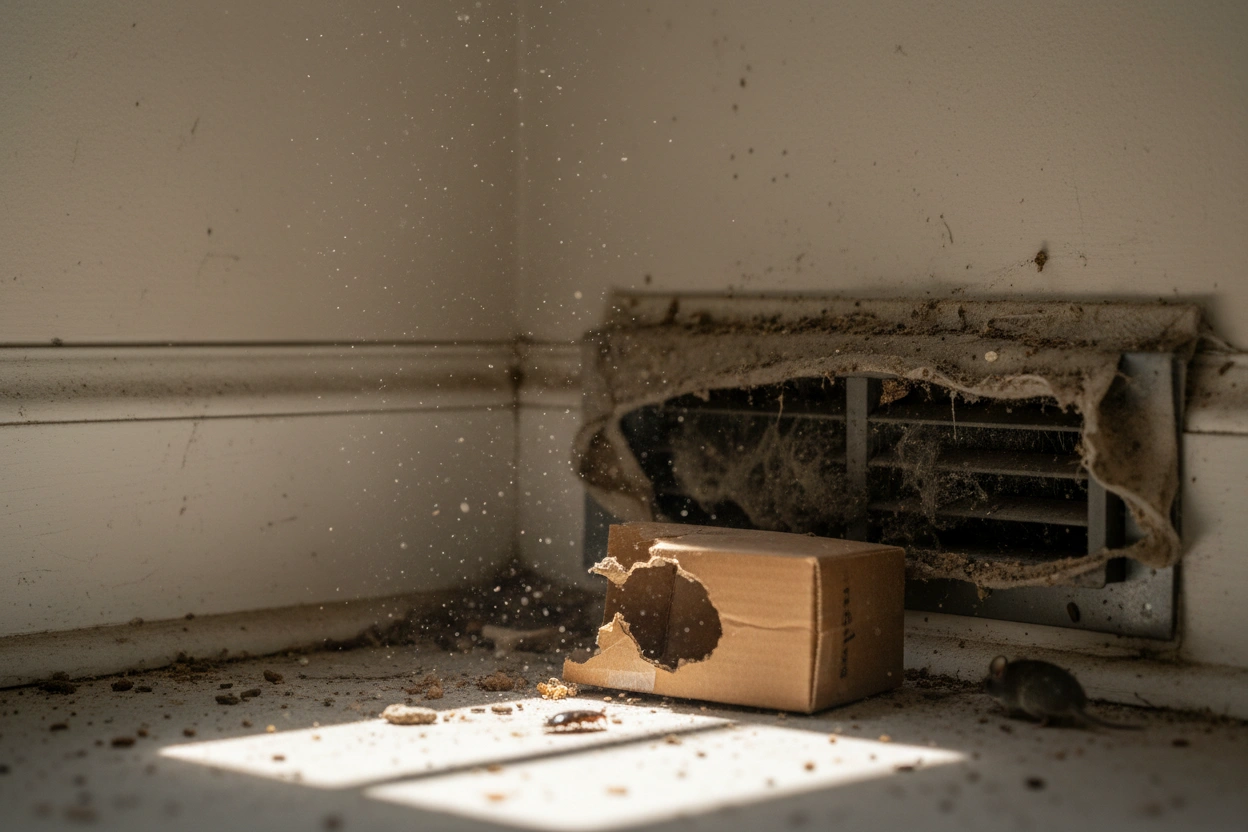
The Rooms and Surfaces Where Pest Allergens Accumulate Most
Understanding where these allergens settle is just as important as knowing what they do to your body. Pest byproducts concentrate in specific zones based on pest behavior, moisture, and airflow patterns.
High-accumulation areas include:
-
Kitchen corners and cabinet gaps — food debris draws roaches, leaving fecal matter and shed exoskeletons
-
Bedroom carpets — dust mites and rodent dander embed deep within fibers
-
Bathroom fixtures and grout lines — moisture attracts pests, accelerating allergen buildup
-
Living room nooks, attic spaces, and basement areas — low-disturbance zones where mice and insects nest undisturbed
You can’t address allergen exposure without first mapping these hotspots.
Regular inspection of these surfaces using HEPA vacuuming and targeted remediation greatly reduces your cumulative allergen load.
Can an Air Quality Test Detect Pest Contamination?
How effectively an air quality test detects pest contamination depends largely on the type of testing method you use and what biological markers it targets.
Standard air quality testing measures particulate matter, VOCs, and humidity but won’t identify pest-specific allergens. For accurate pest detection methods, you’ll need specialized testing that targets cockroach allergens (Bla g1, Bla g2), mouse urinary proteins (Mus m1), or rodent dander.
ELISA-based assays and PCR testing of collected air samples can identify these biological markers with measurable precision. You can also use impaction air sampling to capture airborne particles for allergen analysis.
Without specifying these biomarkers during air quality testing, standard assessments will miss pest contamination entirely, leaving you with incomplete data about your indoor environment’s health risks.
How to Clear Pest Allergens and Restore Indoor Air Quality
Once you’ve identified pest allergens through specialized testing, the next step is systematic removal and air quality restoration. Effective pest control eliminates the source, while targeted air purification addresses residual contaminants.
Implement these evidence-based restoration steps:
-
Deploy HEPA air purifiers rated for your space’s square footage to capture airborne allergen particles.
-
Perform deep cleaning using HEPA vacuums on carpets, upholstery, and wall cavities where allergens accumulate.
-
Seal entry points to prevent recontamination after professional pest control treatment.
-
Replace HVAC filters with MERV-13 or higher-rated filters to intercept circulating allergens.
Post-remediation air quality testing confirms whether allergen levels have returned to acceptable thresholds.
Without verification testing, you’re operating on assumption rather than data-driven confirmation of successful restoration.
Frequently Asked Questions
Can Pest Contamination Affect Indoor Air Quality in Newer Homes?
Yes, pest contamination can affect your newer home’s air quality. You’ll need proactive pest prevention measures and proper air filtration systems, as even modern construction doesn’t eliminate allergens, pathogens, and particulates that pests introduce into indoor environments.
How Long Does Pest-Related Air Contamination Persist After Extermination?
After extermination, you’ll typically face pest-related air contamination persisting for two to eight weeks. Your chosen extermination methods directly influence this timeline, and deploying air purification systems can greatly accelerate the elimination of lingering allergens and chemical residues.
Are Children More Vulnerable to Pest-Related Indoor Air Quality Issues?
Yes, children’s health faces greater risk from pest allergens because their developing immune systems can’t filter contaminants as effectively. You’ll find they’re more susceptible to respiratory issues, triggering asthma and allergic sensitization at considerably higher rates than adults.
Can Seasonal Pest Activity Cause Temporary Spikes in Indoor Allergens?
Yes, seasonal pest activity can spike your indoor allergens. As different pest types emerge cyclically, they’ll intensify your seasonal allergies by depositing increased frass, shed skins, and saliva proteins, temporarily elevating particulate concentrations in your breathing zone.
Does Homeowner’s Insurance Cover Air Quality Damage From Pest Infestations?
Most standard homeowner’s policies exclude pest damage from coverage. You’ll find that insurance claims for air quality issues caused by infestations are typically denied, as insurers classify pest-related deterioration as preventable maintenance negligence.
Conclusion
Pest contamination doesn’t just damage your home’s structure—it systematically degrades the air you’re breathing every day. You’ve seen how allergens from cockroaches, rodents, and dust mites penetrate deep into respiratory tissue, accumulate in high-traffic areas, and persist long after the pests themselves are gone. Addressing this problem requires coordinated elimination, targeted cleaning protocols, and verified air quality testing. Without all three steps, you’re managing symptoms rather than resolving the underlying contamination source.