
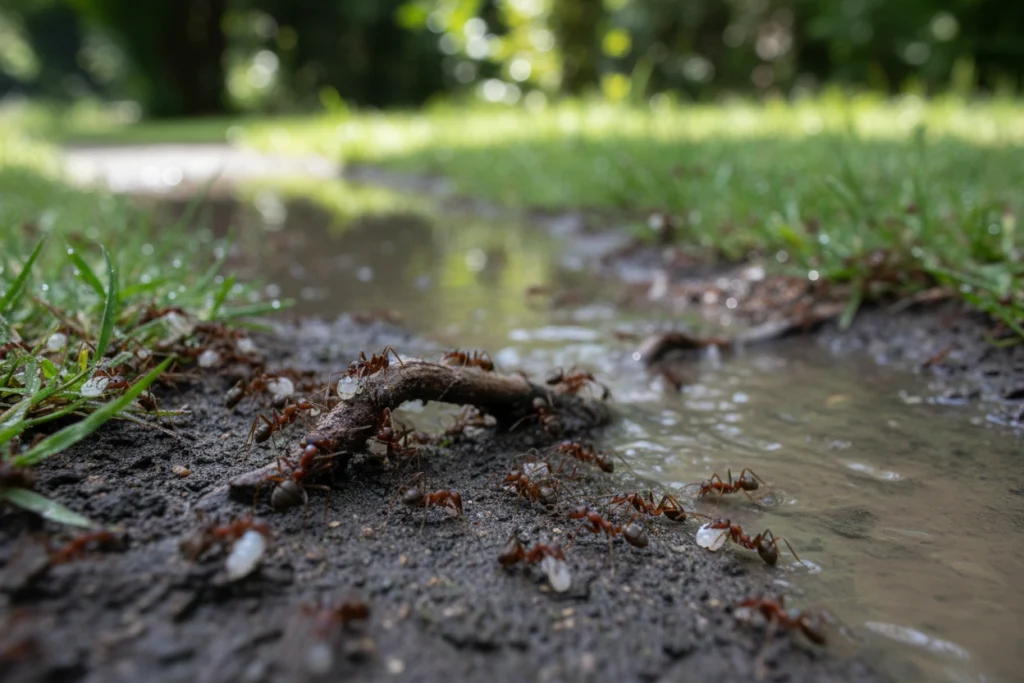
When heavy rain saturates the soil, it displaces the air pockets inside ant colonies, cutting off oxygen and flooding food reserves. Your home’s warmth and dryness become a survival beacon. Workers detect moisture changes through hygroreceptors and mechanoreceptors, triggering coordinated evacuations toward elevated, drier ground. They’re not invading randomly — they’re executing an ancient, highly organized escape protocol. Understanding exactly how this process unfolds can help you anticipate, prevent, and stop it.
Key Takeaways
-
Heavy rain saturates soil, flooding ant colonies and cutting off oxygen, forcing workers to evacuate and seek drier shelter indoors.
-
Workers use hygroreceptors to detect rising moisture levels, triggering coordinated colony evacuations that prioritize relocating queens and brood to safety.
-
Atmospheric pressure drops before storms prompt ants to establish pheromone trails, guiding nestmates toward elevated, dry structures like homes.
-
Rain partially degrades existing scent trails, causing scouts to recalibrate routes along edges, windowsills, and door frames while depositing fresh pheromones.
-
Warm, low-humidity indoor environments provide ideal refuge, attracting ants away from cold, waterlogged soil surrounding their disrupted colonies.
Why Rain and Flooding Force Ants Out of Their Underground Colonies
When heavy rain saturates the soil, it displaces the air pockets within ant colonies, cutting off the oxygen supply that worker ants, larvae, and queens depend on for survival. Rising water tables then flood tunnels, destroying stored food reserves and destabilizing structural chambers.
You’ll notice this triggers immediate ant behavior shifts—workers rapidly relocate brood, queens, and resources toward drier ground. Colony survival depends on this coordinated evacuation response.
Ant species with deeper subterranean colonies face greater displacement risk during prolonged rainfall events. Surface emergence isn’t random; it’s a calculated physiological and structural response to hypoxic and hydrostatic pressure building within the nest.
Understanding these mechanisms helps you recognize why post-rain ant activity spikes dramatically, particularly near foundations, sidewalks, and other elevated or sheltered structures.
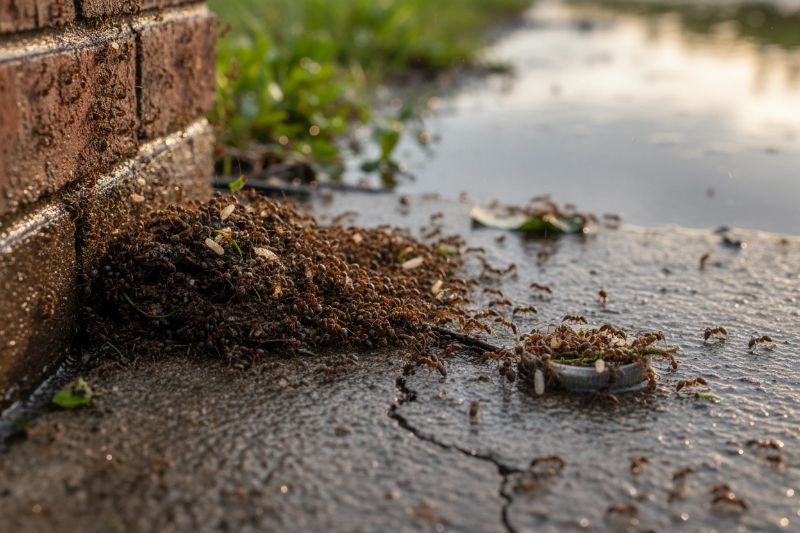
How Rain Triggers Ants to Seek Higher, Drier Ground
When floodwater saturates an ant colony’s tunnels, you’ll notice workers immediately begin relocating brood, food stores, and the queen to higher ground.
Ants detect rising moisture through mechanoreceptors and hygroreceptors, triggering a coordinated evacuation response that prioritizes colony survival over nest integrity.
You can observe this behavior as ants stream toward elevated surfaces—tree bases, building foundations, and rocky outcroppings—where drier, more structurally stable terrain allows rapid nest reconstruction.
Flooded Nests Force Migration
Heavy rainfall can overwhelm an ant colony‘s drainage systems faster than workers can respond, saturating the surrounding soil and cutting off the nest’s oxygen supply. When water infiltrates tunnel networks, workers initiate rapid nest relocation protocols, carrying brood, queens, and food stores toward elevated terrain.
You’ll observe columns of ants emerging from ground-level entry points as survival strategies activate colony-wide. Workers use pheromone signaling to coordinate evacuation routes while scouts identify structurally sound, drier locations. The colony prioritizes queen protection above all else, since reproductive capacity determines long-term survival.
These migration events typically conclude within hours, as prolonged exposure to saturated soil accelerates larval mortality. This biological imperative—not random wandering—explains why ants suddenly appear on your sidewalks, patios, and building foundations following intense precipitation events.
Ants Seek Elevated Shelter
Saturating rainfall triggers three primary physiological and behavioral responses that drive ants toward elevated, drier ground. First, you’ll notice ants activating chemoreceptors that detect atmospheric pressure drops, signaling imminent flooding.
Second, colony workers initiate coordinated pheromone trails directing nestmates toward structurally sound, elevated locations.
Third, soldiers establish defensive perimeters around newly selected shelter sites.
These ant behavior modifications represent sophisticated survival strategies refined through millions of years of evolutionary pressure. When soil moisture reaches critical saturation thresholds, worker ants rapidly assess vertical terrain gradients, prioritizing locations offering drainage, thermal stability, and structural integrity.
You’re fundamentally witnessing a highly organized emergency relocation protocol. Colonies can mobilize thousands of workers within minutes, transporting larvae, pupae, and critical food reserves to secure elevated positions before complete nest inundation occurs.
How Ants Use Scent Trails to Find Their Way Inside After Rain
Rain doesn’t erase ant scent trails instantly—it degrades them, and that distinction matters. Pheromone navigation relies on volatile chemical compounds deposited along established routes. Heavy rainfall dilutes and displaces these compounds, forcing workers to recalibrate their paths using residual chemical gradients.
You’ll notice ants appearing along wall edges, windowsills, and door frames—these aren’t random entry points. Scouts detect surviving scent communication signals and reconstruct viable routes toward interior environments. They’re following attenuated chemical gradients, not exploring blindly.
As scouts confirm interior conditions—stable humidity, food availability, structural shelter—they reinforce new trails with fresh pheromone deposits. Subsequent workers follow with increasing precision.
Within hours, a coordinated foraging network emerges inside your structure, built entirely from chemical information recalibrated after environmental disruption.
The Ant Species Most Likely to Invade After Rain
Not every ant species responds to rainfall with the same urgency or behavioral pattern.
You’ll find that odorous house ants and pavement ants are among the most frequent post-rain invaders, exploiting flooded soil conditions rapidly.
Pharaoh ants, being moisture-sensitive, relocate colonies aggressively when humidity destabilizes their nesting environment.
Carpenter ants abandon waterlogged wood galleries and seek drier structural timber inside your home.
Fire ants construct elaborate drainage mounds but will migrate indoors under extreme saturation.
Sugar ants follow disrupted foraging trails directly into kitchens.
Field ants, though mainly outdoor species, occasionally breach foundations after prolonged rainfall.
Leafcutter ants prioritize colony waterproofing but may shift foraging routes toward sheltered environments.
Recognizing which species you’re dealing with determines the precise treatment strategy you’ll need to implement effectively.
Why Wet Weather Makes Your Home Even More Attractive to Ants
When floodwaters saturate ant colonies and compromise their underground infrastructure, your home presents an immediate refuge with three critical resources: shelter from inundation, accessible food supplies, and consistently warm, dry conditions.
You’ve likely noticed that ants don’t randomly select structures to invade — they’re responding to precise environmental signals that your home broadcasts during wet weather. Understanding these attractants lets you anticipate and disrupt ant incursions before they establish foraging trails inside your living spaces.
Shelter From Flooding
Heavy rainfall saturates soil, collapsing the microscopic air pockets that ant colonies depend on for oxygen exchange and structural integrity.
When hydrostatic pressure exceeds the colony’s structural threshold, workers initiate flood survival protocols — evacuating brood, queens, and food stores through surface tunnels. Your home presents an architecturally superior alternative: elevated foundations, consistent temperatures, and moisture-regulated interiors.
Ant behavior shifts dramatically during these displacement events. Scouts detect your home’s thermal signature and chemical gradients through chemoreception, transmitting pheromone recruitment trails to the colony.
Workers then exploit existing entry points — foundation cracks, utility penetrations, and weatherstripping gaps — with remarkable efficiency.
Understanding this mechanism explains why post-storm ant intrusions aren’t random. You’re observing a calculated, survival-driven migration toward the most structurally stable refuge available.
Indoor Food Sources
Flooded foraging zones force ant colonies to redirect nutritional acquisition strategies toward interior environments, and your home’s food sources become exponentially more attractive during these displacement events.
Your food storage areas—pantries, cabinets, countertops—emit chemical gradients that scout ants detect across considerable distances. Carbohydrate-dense materials, protein sources, and moisture-rich residues create compounding attractant signals during post-rain scarcity periods.
Indoor cleanliness directly correlates with infestation probability. Exposed organic matter, unsealed containers, and accumulated food debris amplify olfactory recruitment signals, triggering exponentially larger worker mobilization into your space.
Scouts deposit pheromone trails communicating precise resource coordinates back to displaced colonies.
Your mitigation strategy requires eliminating these attractant sources systematically—sealed containers, sanitized surfaces, and eliminated moisture residues reduce your home’s palatability to nutritionally-displaced foraging populations.
Warmth and Dry Conditions
Beyond nutritional scarcity, your home offers displaced ant colonies something equally compelling after heavy rain: thermal stability and low humidity. Saturated soil dramatically lowers ambient ground temperature while simultaneously elevating moisture levels, creating physiologically stressful conditions that suppress ant behavior, including foraging efficiency and larval development.
Your home’s regulated interior temperature and dry microclimate directly counteract these climate impact variables. Worker ants respond to thermal gradients by relocating brood chambers toward warmer, drier environments, prioritizing colony survival over territorial boundaries.
Concrete foundations, wall voids, and insulated flooring replicate the stable thermal conditions colonies require for metabolic regulation. Essentially, you’re providing precisely calibrated environmental refuge that waterlogged soil can’t offer.
Understanding this thermoregulatory motivation helps explain why post-rain ant intrusions aren’t random—they’re calculated, physiologically driven responses to environmental destabilization.
How Long a Post-Rain Ant Invasion Typically Lasts
When a post-rain ant invasion strikes your home, you can typically expect it to last anywhere from a few days to two weeks, depending on several key variables.
Ant behavior shifts dramatically once colonies stabilize their internal moisture levels and re-establish functional tunneling systems. If rain patterns continue producing intermittent heavy downpours, you’ll likely see repeated intrusion cycles rather than a single isolated event.
Colony size, species type, and available indoor food sources also directly influence invasion duration. Carpenter ants typically retreat faster than odorous house ants, which aggressively exploit new foraging territories.
You can shorten the invasion window by eliminating moisture sources, sealing entry points, and removing food attractants. Without these corrective measures, ants will continue reconnoitering your living space until outdoor conditions become sufficiently dry and structurally stable.
How to Keep Ants Out After Heavy Rainfall
Keeping ants out after heavy rainfall requires a systematic, multi-layered approach targeting both structural vulnerabilities and behavioral attractants.
Seal foundation cracks and install physical ant barriers along entry points. Apply natural repellents — including diatomaceous earth, peppermint oil, or cinnamon — along thresholds and windowsills.
Position effective traps near high-traffic zones you’ve identified during previous invasions. Practice strict food storage by keeping all consumables in airtight containers.
Implement moisture control by repairing leaky pipes and improving drainage around your foundation.
Follow landscaping tips such as trimming vegetation away from exterior walls and eliminating debris piles that enable nesting prevention.
Maintain outdoor cleaning routines by removing food residue from patios and trash receptacles, eliminating chemical trails ants use to recruit additional colony members.
When to Call a Professional After a Post-Rain Ant Invasion
Most post-rain ant incursions resolve with diligent DIY intervention, but certain infestation indicators signal that professional pest control is necessary. Recognize these critical thresholds in ant behavior:
-
Structural Infiltration — You’re noticing ant trails emerging from wall voids, foundations, or electrical conduits, suggesting deep-seated colony establishment.
-
Species Identification Concerns — You’ve identified carpenter ants or fire ants, whose ant behavior patterns cause significant structural damage or medical risks requiring specialized extermination protocols.
-
Persistent Reinfestation — You’ve applied multiple DIY treatments over two weeks without measurable reduction in ant activity, indicating an unlocated primary colony.
Contact a licensed pest control operator who’ll conduct systematic colony mapping, species-specific chemical application, and structural vulnerability assessment to permanently eliminate the infestation.
Frequently Asked Questions
Can Ants Survive Being Fully Submerged Underwater During Heavy Flooding?
Yes, you’ll find that ants employ remarkable ant survival strategies during floods. They actively form living rafts, trapping air bubbles against their bodies, demonstrating extraordinary flooding behavior that lets them survive full submersion for extended periods.
Do Ants Invade More During Daytime or Nighttime After Rainfall?
You’ll observe that ants exhibit increased daytime activity post-rainfall, as most species are diurnal foragers. However, certain species demonstrate nocturnal behavior, so invasion timing ultimately depends on the specific ant species colonizing your environment.
Are Post-Rain Ant Invasions More Common in Certain Geographic Regions?
Yes, you’ll observe post-rain ant invasions more frequently in tropical and subtropical regions, where ant behavior intensifies due to higher species diversity. Geographic distribution greatly influences invasion frequency, with humid climates experiencing particularly more pronounced post-rainfall ant activity.
Can Heavy Rain Permanently Destroy an Established Ant Colony Underground?
Heavy rain rarely permanently destroys an established colony due to colony resilience. You’ll find ants relocate tunnels, leveraging their moisture preferences to rebuild chambers in drier soil zones, ensuring survival.
Do Ants Communicate Flood Warnings to Each Other Before Rain Arrives?
Ants don’t communicate flood warnings verbally, but you’ll find their ant behavior responds to rain signals like atmospheric pressure drops and humidity shifts, triggering pheromone releases that alert colony members to prepare or relocate preemptively.
After Heavy Rain, Ants Are Looking for a Way In
When soil becomes saturated, ants do not wander indoors by chance. They are relocating to survive, moving away from flooded tunnels and toward dry, stable areas like your home. Moisture buildup around foundations, small entry gaps, and lingering scent trails make it easier for colonies to reestablish indoors after a storm. Addressing these conditions early can help prevent repeated invasions.
If you are seeing persistent ant activity after heavy rain, it may point to a deeper vulnerability around your home’s exterior. Pest Patrol can inspect problem areas and recommend a targeted solution that goes beyond basic prevention. Contact Pest Patrol for a free quote and take the next step toward keeping ants out, even during the wettest conditions.