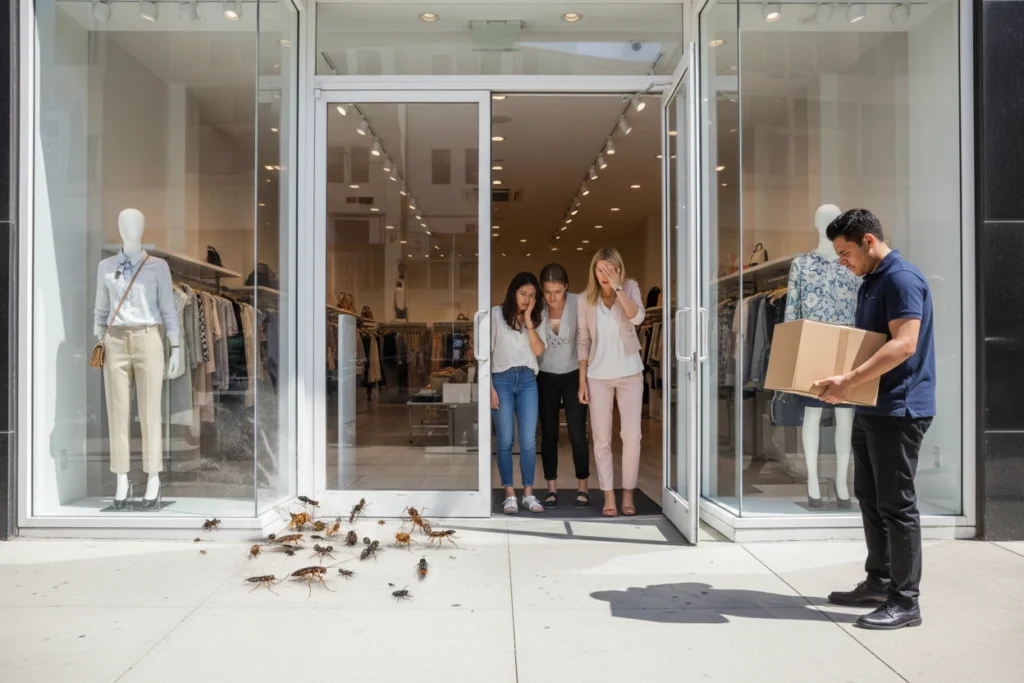
Your storefront entrance is the highest-risk zone for pest activity in your entire retail operation. Ants track food scent trails across door thresholds, cockroaches concentrate under mats and near drains, and rodents exploit delivery gaps before customers ever step inside. A single pest sighting triggers immediate exit behavior, negative reviews, and permanent brand damage that marketing can’t undo. Understanding why these pressure points exist is the first step toward protecting what customers see first.
Key Takeaways
-
A single pest sighting at a storefront entrance triggers immediate customer exit and often results in lasting negative online reviews.
-
Ants, cockroaches, and spiders commonly target entryways through door threshold gaps, deteriorating weatherstripping, and utility penetrations.
-
Customers who spot one pest typically assume a widespread infestation, causing permanent brand damage that marketing cannot reverse.
-
High-traffic entry points require faster-acting, discreet pest control treatments that comply with health regulations and avoid customer exposure.
-
Seasonal pest pressures shift throughout the year, requiring adjusted inspection and treatment strategies to keep storefronts consistently pest-free.
What Pests Are Actually Lurking Near Your Storefront?
Retail storefronts attract a predictable cast of pests, each drawn by specific conditions your building creates. Entrances generate foot traffic, food debris, and warmth—conditions that support common pest habitats for ants, cockroaches, rodents, and spiders.
Ants follow food scent trails along door thresholds. Rodents exploit delivery gaps and dumpster proximity. Cockroaches concentrate in drain areas and beneath door mats where moisture accumulates. Spiders establish webs in recessed lighting and sign fixtures.
Applying pest identification techniques lets you connect visible evidence—droppings, grease marks, webbing—to specific species before infestations escalate. Additionally, implementing integrated pest management strategies can help ensure a long-term solution to these issues.
Each pest requires a distinct response strategy, so misidentification wastes time and resources. You’ll resolve problems faster when you understand exactly which pest you’re dealing with and why your storefront is drawing it in.
How Pests at the Door Drive Customers Away for Good
Knowing which pest is at your door matters far less if customers never come back through it.
Pest visibility at your entrance directly damages customer perceptions in measurable ways:
-
Immediate exit behavior – Shoppers who spot a pest turn around before entering, reducing foot traffic instantly.
-
Negative online reviews – A single sighting generates public complaints that persist in search results long-term.
-
Assumption of widespread infestation – Customers rarely think one ant or cockroach is isolated.
-
Permanent brand damage – Most customers won’t return after a pest encounter, regardless of discounts or apologies.
You won’t recover lost trust through marketing alone.
Addressing pest visibility at your storefront entrance requires a structured, professional treatment plan before customer perceptions deteriorate beyond repair. Additionally, implementing integrated pest management strategies can help maintain a long-term pest-free environment and enhance customer confidence.
The Entry Points Retailers Most Commonly Overlook
Even a thorough interior treatment fails when pests continue entering through gaps you haven’t identified. Retailers most commonly overlook hidden access points along door sweeps, utility penetrations, and drain lines — areas that receive little attention during routine inspections.
Gaps behind display cases, neglected corners near loading dock thresholds, and deteriorating weatherstripping around secondary entrances create low-resistance pathways that pests exploit repeatedly. Pipe chases running through exterior walls and unsealed conduit openings compound the problem.
You should conduct a methodical perimeter audit that traces every utility entry point, checks frame integrity at all exterior doors, and identifies grade-level cracks in the foundation. Without systematically mapping these vulnerabilities, even aggressive treatment schedules won’t stop reinfestation. Recognizing the true scope of pest problems is essential for preventing these access points from becoming major issues.
Closing hidden access permanently requires structural precision, not just chemical application.
Why Retail Pest Control Needs a Different Approach
Retail environment considerations demand protocols that account for open public access, product contamination risks, and customer perception impacts simultaneously.
A qualified technician structures treatment around four operational realities:
-
Treatment windows must align with store hours to avoid customer exposure to chemicals or equipment.
-
Product zones require food-safe or low-residue formulations to prevent contamination.
-
Visible treatment areas demand discreet application methods that don’t alarm shoppers.
-
High-traffic entry points need faster-acting solutions because pest pressure resets constantly.
You’re not just managing an infestation—you’re protecting a brand.
Every decision a technician makes has to account for what your customers will see, smell, and experience. Additionally, effective pest control solutions ensure compliance with health regulations, safeguarding your business’s reputation and financial standing.
Seasonal Pest Pressures Portland Retailers Should Expect
Protecting your brand from pest pressure isn’t just about how you treat—it’s also about when and what you’re treating for. Seasonal trends directly shape pest behavior in Portland, and anticipating those changes keeps you ahead of infestations rather than reacting to them.
-
Spring: Ant colonies expand and begin foraging; moisture pests increase near entrances.
-
Summer: Wasps, yellow jackets, and flies peak; dumpster areas become high-risk zones.
-
Fall: Rodents seek warmth indoors as temperatures drop; spider activity increases.
-
Winter: Cockroaches and rodents press deeper into heated structures; bed bug risks persist year-round.
Each seasonal shift requires adjusted inspection protocols, targeted treatments, and updated exclusion strategies. Understanding the financial impact of pest infestations on your business can also drive proactive measures.
Knowing which pests become active—and when—lets you protect your storefront before customers ever notice a problem.
How Professional Storefront Pest Control Actually Works
When you hire a professional pest control company for your retail storefront, the process follows a structured sequence—not a one-size-fits-all spray-and-leave approach.
Technicians apply systematic pest identification methods and targeted prevention strategies across every service visit.
The process typically includes:
-
Inspection – Technicians assess entry points, moisture sources, and conducive conditions throughout your storefront.
-
Identification – Species-specific identification determines which treatments apply and where.
-
Treatment – Targeted applications address active infestations using methods appropriate for customer-facing environments.
-
Prevention – Exclusion work, monitoring stations, and sanitation recommendations reduce future pressure.
You’ll also receive documentation after each visit, giving you a clear record of findings and actions taken—something health inspectors and corporate auditors often request.
Frequently Asked Questions
Does Pest Control Treatment Require My Store to Close Temporarily?
Most pest control methods don’t require closure. You’ll typically stay open during treatment, though treatment frequency and product type determine brief access restrictions to specific zones, letting you maintain normal business operations efficiently.
Are Pest Control Chemicals Safe Around Food Products and Displays?
Most treatments guarantee chemical safety around your store, but you’ll want to cover or remove food products and displays beforehand. We’ll apply targeted, low-toxicity formulations precisely where needed, maintaining strict food protection protocols throughout the entire process.
How Much Does a Commercial Storefront Pest Control Plan Typically Cost?
Pest control pricing varies based on your storefront’s size, infestation severity, and service frequency. You’ll typically pay $100–$300 monthly for recurring commercial plans. Contact Pest Patrol for a precise quote tailored to your Portland-area business.
Will Pest Control Services Disrupt My Customers or Daily Business Operations?
Most treatments won’t disrupt your operations. Technicians schedule visits around your peak hours, applying targeted solutions that address pest behavior efficiently. This minimizes customer perception issues while keeping your storefront active, safe, and fully functional throughout the process.
Can I Schedule Pest Control Treatments Outside of Normal Business Hours?
Yes, you can arrange pest control scheduling outside standard hours. Pest Patrol offers after hours treatments to minimize disruption, letting technicians treat your storefront efficiently while you’re closed, protecting customers and maintaining uninterrupted daily operations.
Conclusion
Your storefront entrance functions as your business’s primary conversion point — and pests compromise that function directly. You’re not just managing insects when you implement structured pest control protocols; you’re protecting revenue, reputation, and customer retention simultaneously. By sealing entry points, maintaining consistent treatment schedules, and partnering with a Portland-area pest control professional, you’re systematically eliminating the variables that undermine first impressions. Don’t let an uncontrolled pest presence erase the investments you’ve made in your retail environment.