

When temperatures climb above 80°F, flies become a notably bigger problem because heat compresses their development cycle from nearly a month down to just seven days. That acceleration allows multiple overlapping generations to emerge before summer ends. Warmer conditions also speed up organic decay, creating more breeding sites while increasing flies’ metabolic activity, making them more frequent feeders and more effective bacterial vectors. What follows breaks down exactly what you’re up against.
Key Takeaways
-
Above 80°F, flies develop from egg to adult in just seven days, allowing multiple overlapping generations to emerge rapidly.
-
Each female housefly lays up to 500 eggs, meaning faster development cycles in heat cause exponential population growth.
-
Hot weather accelerates organic matter decay, creating more breeding sites in garbage bins, compost piles, and drains.
-
Warm temperatures increase fly metabolic activity, causing more frequent feeding and defecation, raising bacterial transmission risks significantly.
-
Heat attracts multiple fly species simultaneously, including blow flies, fruit flies, and fungus gnats, worsening overall infestations.
Why Flies Multiply So Fast in Hot Weather
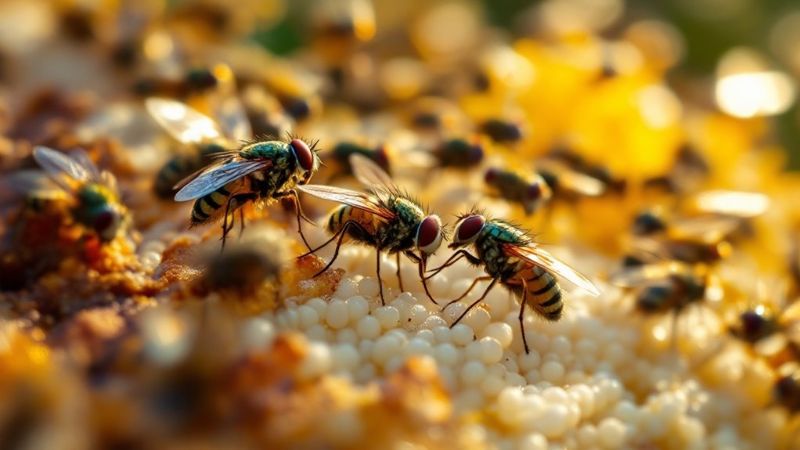
Heat accelerates every stage of the fly life cycle, which is why infestations can seem to appear overnight during summer. At temperatures above 80°F, a fly can complete its development from egg to adult in as little as seven days.
Under cooler environmental conditions, that same cycle can take three to four weeks.
You’re dealing with a compounding problem. Each female housefly lays up to 500 eggs in her lifetime, and when warm temperatures shorten the development window, multiple generations overlap rapidly.
The key fly reproduction factors driving this surge include heat-accelerated larval development, increased metabolic activity, and abundant decaying organic matter that summer produces naturally.
Understanding this cycle helps you recognize why warm weather demands faster, more proactive intervention.
Which Flies Are Most Active in Summer Heat
Not all fly species respond equally to rising temperatures, and knowing which ones peak in summer helps you anticipate where problems are most likely to develop.
Houseflies behavior intensifies markedly above 80°F, as warmth accelerates their metabolism, feeding frequency, and reproductive cycles. You’ll find them congregating near food waste, animal matter, and moist organic debris.
Blow flies and flesh flies follow similar thermal patterns, targeting exposed proteins and carrion.
Fruit flies’ attraction to fermented sugars increases sharply in summer, particularly around overripe produce, recycling bins, and drains where organic residue accumulates.
Fungus gnats thrive wherever soil moisture combines with heat.
Each species occupies a distinct ecological niche, so identifying which fly you’re dealing with directly determines where the infestation originates and how you should respond. Additionally, environmental factors such as standing water can exacerbate infestations, making proactive management essential.
What Hot Weather Does to Fly Breeding Sites
When temperatures climb above 80°F, organic matter breaks down faster, compressing the window between a clean environment and an active breeding site.
Seasonal changes accelerate microbial activity, which generates heat within decaying material and further intensifies breeding conditions.
Hot weather transforms common areas into fly nurseries:
-
Garbage bins reach internal temperatures that liquefy organic waste within hours
-
Compost piles decompose rapidly, creating dense microbial hotspots
-
Standing water evaporates unevenly, concentrating organic particles in residual pools
-
Pet waste dries on the surface while retaining moisture underneath
-
Drain buildup ferments faster, supporting phorid and drain fly larvae
You’re not dealing with a static problem.
Each degree of temperature increase measurably shortens the fly development cycle, compounding infestation pressure throughout summer.
How Flies Spread Bacteria Faster When Temperatures Rise
As temperatures climb, flies don’t just breed faster—they become considerably more effective vectors for bacterial transmission. Warmer conditions accelerate their metabolic activity, causing them to feed, defecate, and regurgitate more frequently. Each of these actions deposits pathogens onto whatever surface the fly contacts.
Temperature effects also influence bacterial survival on the fly’s body. Heat increases microbial replication rates both within the fly’s gut and on its external surfaces, meaning each landing transfers a higher bacterial load.
Flies carry pathogens like Salmonella, E. coli, and Listeria across multiple surfaces within minutes.
You’re at greater risk during summer months because flies move rapidly between contaminated sources—garbage, animal waste, decaying matter—and your food preparation areas, completing that transmission cycle with alarming efficiency.
Simple Ways to Keep Flies Out During Summer
Reducing fly entry during summer requires addressing both structural vulnerabilities and behavioral attractants systematically.
Applying fly prevention tips consistently throughout warmer months greatly limits infestation risk.
Summer sanitation forms the behavioral foundation of effective fly control. You’ll want to implement these targeted measures:
-
Seal gaps around doors, windows, and utility penetrations with weatherstripping or caulk
-
Install fine-mesh screens on all openings, including vents
-
Empty garbage containers frequently and secure lids tightly
-
Eliminate standing water, overripe produce, and organic debris immediately
-
Clean food preparation surfaces and drain lines regularly
Each measure disrupts a specific fly attractant or entry pathway.
Combining structural exclusion with disciplined sanitation creates compounding protective effects.
Neglecting either category allows fly populations to exploit remaining vulnerabilities despite partial preventive efforts. Additionally, maintaining a sanitization routine is critical in reducing attractants that can invite flies into your establishment.
When to Call a Pest Control Professional for Flies
If you’re spotting flies consistently in large numbers, discovering maggots near food or waste areas, or noticing multiple species simultaneously, you’re likely facing an infestation that exceeds basic DIY control.
These signs indicate an established breeding source nearby—one that requires systematic identification and targeted elimination rather than surface-level suppression.
A licensed pest control professional brings diagnostic tools, species-specific treatments, and source-elimination strategies that resolve infestations faster and more thoroughly than consumer-grade solutions. Additionally, addressing root causes of infestations is crucial for long-term prevention.
Signs of Infestation
While the occasional fly indoors is normal, certain signs indicate a more serious infestation requiring professional intervention. Monitoring fly behavior and maintaining property cleanliness helps you identify when the problem exceeds DIY management.
Watch for these infestation indicators:
-
Consistent large fly clusters congregating near windows, drains, or food sources
-
Maggot presence in garbage areas, soil, or decaying organic matter
-
Multiple fly species appearing simultaneously throughout your property
-
Persistent activity despite thorough cleaning and waste removal efforts
-
Dark fly specks (excrement deposits) accumulating on walls, ceilings, or surfaces
If you’re observing these signs regularly, the underlying breeding source likely requires professional identification and treatment.
A pest control specialist can locate hidden infestation points that standard sanitation measures won’t eliminate.
Professional Treatment Benefits
When fly activity persists despite sanitation improvements and waste management, the infestation has likely advanced beyond DIY control.
Professionals identify breeding sites you may overlook, assess species-specific behaviors, and deploy effective treatments calibrated to infestation severity.
Licensed technicians also apply eco friendly solutions that minimize chemical exposure to your family and pets—a critical advantage during summer when children and animals spend more time outdoors.
They target larval development zones, not just adult populations, disrupting the reproductive cycle at its source.
If you’re noticing cluster fly activity indoors, recurring blow fly presence near structural voids, or persistent fruit fly emergence despite food source elimination, contact Pest Patrol.
Serving Portland and surrounding communities, they provide fast response times and back every service with a 100% satisfaction guarantee.
Frequently Asked Questions
At What Temperature Do Flies Become Most Dangerous to Human Health?
Fly-borne diseases peak when temperatures exceed 80°F (27°C). At these temperature thresholds, you’ll find flies reproducing rapidly, bacteria multiplying faster on contaminated surfaces, and pathogen transmission intensifying, making health risks considerably more dangerous.
Can Flies Cause Problems for Outdoor Pets During Summer Months?
Yes, flies can seriously threaten your pet’s health during summer. In outdoor environments, fly behavior intensifies, increasing summer risks like wound myiasis, eye infections, and disease transmission, directly compromising pet health through persistent larval infestation and bacterial contamination.
Do Flies Develop Resistance to Common Insecticides Over Time?
Yes, flies can develop insecticide resistance over generations, making repeated chemical treatments less effective. You’ll find that targeting fly breeding sites directly remains a more reliable, sustainable strategy than depending solely on insecticides.
How Long Does a Typical Fly Infestation Last Without Treatment?
Without treatment, you’re looking at an indefinite infestation. The fly lifecycle—egg to adult in 7–10 days—enables rapid reinfestation. If you’re spotting infestation signs like clusters or larvae, populations will continuously expand without intervention.
Are Some Portland Neighborhoods More Prone to Summer Fly Problems?
Yes, certain Portland neighborhoods exhibit higher urban fly populations. You’ll find areas near food processing facilities, restaurants, or poor neighborhood sanitation infrastructure attract markedly more flies, amplifying your summer infestation risk considerably.
Conclusion
As temperatures climb, you’re facing a compounding problem: accelerated fly reproduction, expanded breeding sites, and heightened bacterial transmission risk. You’ve seen how heat shortens fly development cycles, intensifies contamination threats, and drives infestations into your living spaces. By eliminating breeding sources, sealing entry points, and monitoring high-risk areas consistently, you’ll disrupt the biological conditions flies exploit. When infestations exceed manageable thresholds, professional intervention becomes your most analytically sound course of action.