
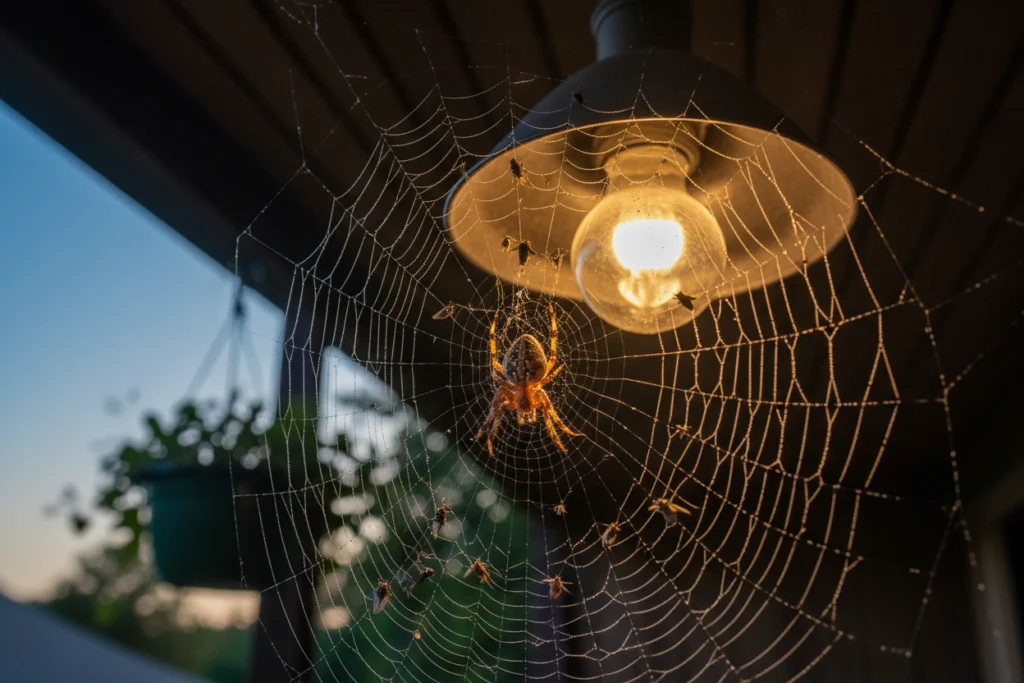
Spiders build webs around your porch lights because they’re exploiting a predictable food chain reaction. Your light disrupts insects’ natural navigation, pulling them in through phototaxis. Spiders recognize this concentrated prey activity and anchor webs directly in those flight paths. Rather than hunting, they let the light do the work. It’s a passive, energy-efficient strategy that turns your porch into a reliable feeding station—and there’s far more to this calculated behavior than you’d expect.
Key Takeaways
-
Porch lights disorient insects through phototaxis, creating dense concentrations of prey that spiders strategically exploit for effortless hunting.
-
Spiders anchor webs near light sources to intercept disoriented insects, maximizing captures without expending energy on active pursuit.
-
Light pollution transforms porches into reliable hunting grounds, giving spiders a consistent, predictable food supply.
-
Different spider species engineer specific web styles, like orb or cobweb designs, to capture various insects near lights.
-
Passive web hunting near porch lights creates a caloric surplus, making these locations ideal for spider survival.
Why Porch Lights Attract Insects in the First Place
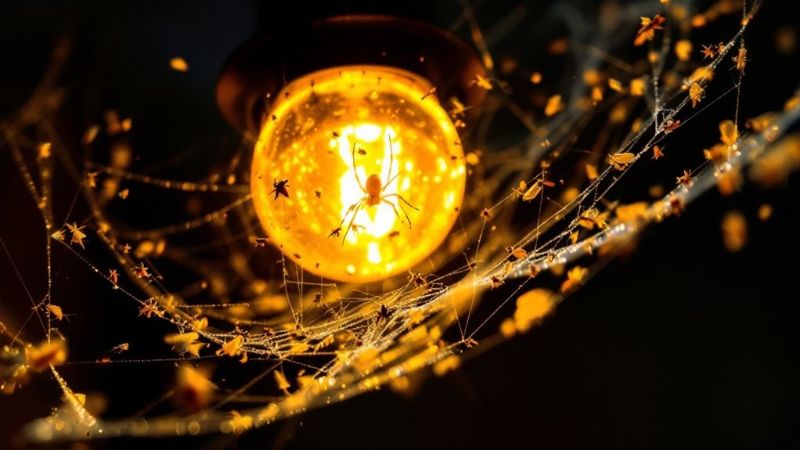
Artificial lights disrupt insects’ navigational systems, drawing them in droves to your porch each night. Insects historically used natural light sources—the moon and stars—to orient themselves during nocturnal movement. Your porch light overrides these ancient navigational cues, triggering a phenomenon called phototaxis, where insects compulsively move toward artificial illumination.
Insect behavior around light sources follows predictable patterns. Phototropic species, including moths, beetles, and flies, lock onto your porch light’s wavelength and spiral inward, unable to recalibrate their internal compass.
Ultraviolet and short-wavelength light spectrums attract the greatest insect concentrations, which explains why traditional incandescent and fluorescent bulbs generate dense insect activity. This concentrated prey availability doesn’t go unnoticed—spiders quickly recognize your porch light as a reliable, high-traffic feeding station worth colonizing with their webs. Additionally, during high humidity levels, insects tend to breed more rapidly, further increasing their presence around lights.
How Spiders Use Light to Hunt Without Moving
When insects converge on your porch light, spiders don’t pursue them—they intercept them.
By anchoring webs near light sources, spiders position their silk strands directly within the flight paths of disoriented insects, turning your light fixture into a passive feeding station.
This strategy lets spiders conserve metabolic energy while maximizing prey capture, exploiting your lighting rather than expending effort on active hunting.
Light Attracts Spider Prey
Porch lights don’t attract spiders directly—they attract the insects spiders feed on.
Artificial light disrupts natural insect behavior, pulling moths, gnats, and flies into tight, predictable zones. Light pollution fundamentally concentrates prey, transforming your porch into a high-yield hunting ground.
Insects gather near light sources for three measurable reasons:
-
Phototaxis – Many insects are positively phototactic, meaning they move instinctively toward light sources.
-
Navigation disruption – Artificial light interferes with lunar navigation, trapping insects in looping flight patterns near the bulb.
-
Heat attraction – Incandescent and halogen bulbs emit heat, drawing additional insects seeking warmth.
Spiders recognize this concentration and position webs strategically to intercept prey.
You’re not just leaving a light on—you’re operating an unintentional insect trap that feeds web-building activity.
Webs Intercept Flying Insects
The spider doesn’t chase its prey—it engineers a structure that does the work instead. By positioning web types strategically near your porch light, spiders exploit predictable insect behavior to maximize capture rates.
Orb weavers construct vertical, spiral webs that intercept moths and beetles flying in erratic loops toward the light source. Cobweb spiders build irregular, three-dimensional tangles that snag crawling and low-flying insects disoriented by prolonged light exposure.
You’re fundamentally watching a passive hunting system optimized through evolutionary precision. The web’s placement isn’t random—spiders select angles that intersect the most concentrated flight corridors around the light.
Sticky silk immobilizes prey on contact, and vibration-sensitive legs alert the spider instantly. The light does the attracting; the web does the capturing.
Spiders Conserve Hunting Energy
-
Prey arrives continuously without active pursuit.
-
Web vibrations signal exact prey location, eliminating search behavior.
-
Capture-to-consumption cycles repeat without territorial repositioning.
This energy conservation model means spiders near your porch light operate at a significant caloric surplus compared to free-ranging hunters.
Each intercepted moth or gnat represents net energy gain with virtually zero locomotion cost.
You’re fundamentally funding a passive hunting operation every night your light runs.
The longer that light stays on, the more energetically profitable your porch becomes as a permanent web-building site.
Which Spider Species Build Webs Around Porch Lights
Several spider species consistently exploit porch light environments, each bringing distinct web architectures and hunting strategies.
Among the most common porch spiders you’ll encounter are orb-weavers (Araneae: Araneidae), particularly Larinioides sclopetarius, which constructs precise geometric webs that intercept flying insects with remarkable efficiency.
Cobweb spiders (Theridiidae), including Parasteatoda tepidariorum, use irregular three-dimensional web building techniques to trap crawling and flying prey simultaneously.
Long-jawed orb-weavers (Tetragnathidae) favor humid porch corners, building elongated horizontal webs near moisture sources.
Funnel weavers (Agelenidae) construct flat, sheet-like webs with tubular retreats tucked into structural gaps.
Each species selects microhabitats based on light intensity, structural geometry, and prey availability, meaning your porch’s specific configuration directly determines which species colonize it. Additionally, the presence of natural repellents can influence spider activity around your porch lights.
Does Your Porch Light Color Make a Difference?
The color temperature of your porch light directly influences which insects it attracts, and by extension, how many spiders will congregate nearby to hunt them.
Cool, blue-spectrum bulbs (5000K+) emit higher levels of ultraviolet light, drawing considerably more moths, beetles, and other flying insects than warm-spectrum alternatives.
Switching to warm yellow or amber bulbs (2000K–3000K) reduces insect attraction, subsequently giving spiders less reason to build webs around your entryway.
Warm Vs. Cool Bulbs
When choosing a porch light, bulb color temperature plays a measurable role in how strongly you attract insects—and, by extension, spiders.
Cool white bulbs (5000K+) emit more blue-spectrum light, drawing considerably more insects than warm alternatives.
Consider these distinctions:
-
Warm LED bulbs (2700K–3000K) emit minimal UV output, reducing insect attraction without sacrificing bulb brightness.
-
Cool white or daylight bulbs closely mimic natural daylight spectra, triggering stronger phototactic responses in flying insects.
-
LED advantages over incandescent include lower heat emission, which further reduces insect congregation around the fixture.
You’ll disrupt fewer insect flight patterns—and attract fewer web-building spiders—simply by switching to a warm-spectrum LED bulb on your porch.
Best Colors To Use
Beyond color temperature, the actual color of your porch light influences insect attraction in measurable ways.
Color psychology applied to entomology confirms that insects navigate using ultraviolet and short-wavelength light. Blues and whites fall within that visible spectrum, making them highly attractive to flying insects—and consequently, to spiders hunting them.
Yellow and amber bulbs emit longer wavelengths that most insects can’t effectively detect, reducing the prey concentration near your entrance. Red-spectrum bulbs perform similarly, yielding minimal insect activity.
Bulb brightness compounds the color variable considerably. A dim yellow bulb outperforms a bright blue one in reducing insect traffic.
You’ll get the best results by combining low-attraction color with reduced bulb brightness, systematically cutting off the food supply that makes your porch web-building territory.
Simple Ways to Reduce Spiders Around Porch Lights
Reducing spider activity around porch lights requires addressing the core attractant: insects. Eliminate the prey source, and you disrupt the spider’s incentive to build webs nearby.
-
Switch to yellow or sodium vapor bulbs — these wavelengths attract considerably fewer insects than standard white or UV-emitting lights.
-
Apply natural repellents — peppermint or eucalyptus essential oils diluted in water and sprayed along door frames and light fixtures create chemical deterrents spiders actively avoid.
-
Follow consistent cleaning tips — remove existing webs weekly using a brush or vacuum; eliminating anchor points discourages reconstruction.
You should also seal gaps around light fixtures and doors, cutting off insect entry points entirely. Additionally, reducing other insect populations lowers the food sources available for spiders, further discouraging them from nesting nearby.
Combining light modification, repellents, and routine cleaning produces measurable, compounding reductions in spider web activity.
When Porch Spiders Are a Sign of a Bigger Pest Problem
Persistent spider activity around your porch light often signals a deeper infestation rather than an isolated nuisance.
Spiders are predators — their sustained presence indicates a reliable prey population nearby. If you’re consistently seeing webs rebuilt overnight, you’re likely dealing with significant underlying insect activity inside your walls, attic, or foundation.
Spider infestations rarely resolve without addressing the root cause. Eliminating the spiders themselves without reducing the prey supply produces only temporary results.
Effective pest management requires a systematic assessment of your home’s insect pressure, entry points, and harborage conditions.
Watch for these indicators that the problem extends beyond your porch:
-
Webs appearing in multiple exterior zones
-
Increased indoor spider sightings
-
Visible insect swarms near lighting after dark
-
Recurring infestations despite repeated removal efforts
Additionally, termite treatment costs can escalate significantly if the issue is left unaddressed, leading to more extensive damage and higher expenses.
Frequently Asked Questions
Are Porch Spiders in Portland More Active During Certain Seasons?
You’ll notice porch spiders exhibit peak seasonal behavior during late summer and fall. Environmental factors like temperature, humidity, and insect prey availability drive their increased activity, making Portland’s mild, wet climate particularly conducive to year-round spider presence.
Can Spider Webs Around Porch Lights Damage My Home’s Exterior?
Spider webs won’t structurally damage your home’s exterior, but they’ll accumulate debris, moisture, and staining that complicate home maintenance. Consistent pest control measures help you prevent unsightly buildup and reduce conditions attracting web-spinning spiders near your porch lights.
Is Professional Spider Treatment Safe for Children and Pets?
Yes, professional spider treatment safety protocols protect your children and pets effectively. Pest Patrol’s technicians apply targeted, low-toxicity compounds, and you’ll follow specific child pet precautions—like temporary area avoidance—until treatments fully dry and dissipate.
How Quickly Can Spiders Rebuild Webs After Removal?
Spiders can rebuild webs within 1–2 hours, demonstrating remarkable web rebuilding speed and spider web resilience. If you don’t eliminate the spider population itself, you’ll continuously face reconstruction around your porch lights. Professional treatment targets the source directly.
Do Porch Spiders Bite, and Are They Dangerous to Humans?
Most porch spiders won’t bite unless you threaten them. Their spider behavior is defensive, not aggressive. If bitten, you’ll notice mild bite symptoms like redness or swelling—rarely serious unless it’s a hobo or black widow spider.
Conclusion
Now that you’ve examined the behavioral ecology driving spider web placement near porch lights, you can make informed decisions about your lighting environment. You’re fundamentally managing a localized food web when you control insect attraction. By switching to yellow-spectrum bulbs, reducing unnecessary lighting, and monitoring for underlying pest pressures, you’ll disrupt the prey-predator cycle that makes your porch attractive to web-building species in the first place.