
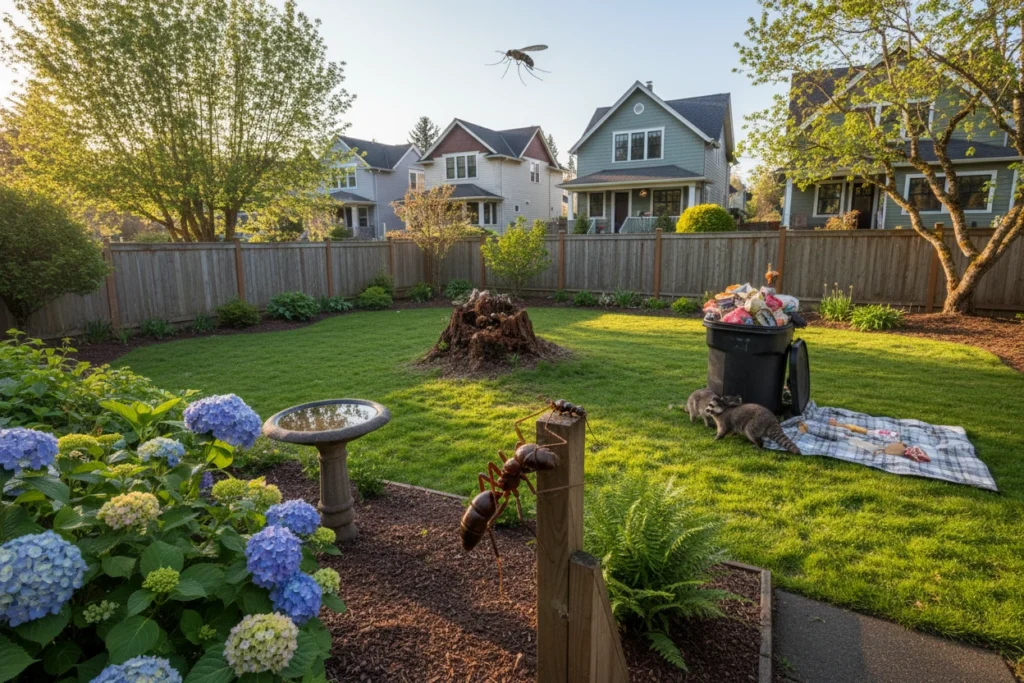
Portland’s first warm week doesn’t create a pest problem — it reveals one that’s been building all winter beneath your feet. Pests don’t disappear in winter; they enter diapause, sheltering in soil, wall voids, and structural gaps while waiting for temperatures to exceed 50°F. Portland’s 37 inches of annual rainfall preserves eggs and larvae underground throughout winter. Once warmth arrives, emergence happens explosively. Understanding what’s happening beneath the surface helps you act before the surge begins.
Key Takeaways
-
Soil temperatures exceeding 50°F trigger explosive ant colony emergence, with scouts appearing almost immediately after the first warm spell.
-
Overwintering pests sheltering in wall voids and wood galleries become active again once temperatures consistently rise above dormancy thresholds.
-
Portland’s average 37 inches of rainfall keeps pest eggs and larvae viable underground, enabling rapid population surges when warmth arrives.
-
Temperature fluctuations during the first warm week can prematurely activate multiple pest species simultaneously, creating overlapping infestation pressures.
-
Rodents expand foraging ranges beyond winter shelters, increasing structural intrusion attempts as interior food sources become more accessible.
Why Portland Pests Disappear Every Winter
Portland’s wet, mild winters might seem hospitable to pests, but most species either die off, migrate, or enter a dormant state called diapause once temperatures consistently drop below 50°F.
During winter dormancy, metabolic processes slow dramatically, suspending reproduction, feeding, and movement. You’ll notice pest behavior fundamentally halts across most species — insects cease egg-laying, rodents reduce foraging ranges, and overwintering adults shelter deep within soil, bark, or structural voids.
Portland’s temperature fluctuations complicate this cycle; brief warm spells can temporarily interrupt diapause, triggering premature activity before conditions stabilize.
However, sustained cold suppresses populations effectively, reducing visible infestations to near zero. Understanding this seasonal biological pause explains why pest pressure doesn’t simply disappear permanently — populations remain viable, waiting for thermal cues to resume activity.
Why Portland’s Wet Winters Make Spring Pest Surges Worse
While winter suppresses pest populations, Portland’s seasonal rainfall creates subsurface conditions that amplify spring emergence dramatically. Sustained moisture impact penetrates soil layers, maintaining humidity levels that preserve insect eggs, larvae, and pupae through cold months.
You’re fundamentally watching a biological incubator operate underground throughout December and February.
Saturated soil accelerates pest lifecycle dynamics by shortening developmental intervals between larval and adult stages. Moisture-rich organic matter beneath your lawn and garden beds provides consistent nutrition for developing grubs, fungus gnats, and moisture-dependent beetles.
When soil temperatures rise above 50°F, these populations don’t gradually emerge—they erupt simultaneously.
Portland’s average 37 inches of annual rainfall creates ideal overwintering preservation conditions. You’re not dealing with a recovering population in spring; you’re confronting one that never meaningfully declined.
What Portland Pests Are Actually Doing All Winter Long
While you’re bundled up indoors, Portland’s pests are executing precise survival strategies to outlast winter’s cold and moisture.
Insects like overwintering yellowjackets and box elder bugs seek out insulated voids inside your walls, attics, and crawl spaces, where they enter a dormant-like state called diapause to conserve energy.
Rodents, meanwhile, remain active year-round, quietly nesting within your home’s structural cavities and feeding on cached food supplies until warmer temperatures signal them to expand their territory.
Winter Pest Survival Strategies
When winter arrives in Portland, local pests don’t simply vanish—they shift into carefully adapted survival modes that keep populations viable until spring. Understanding these overwintering techniques helps you anticipate what you’ll face once temperatures climb.
Rodents exploit structural gaps to access heated interiors, maintaining active colonies throughout the cold months.
Carpenter ants enter diapause, suspending metabolic activity inside wood galleries until warmth triggers renewed activity.
Stink bugs aggregate inside wall voids, sharing thermal mass to reduce individual heat loss.
Pest resilience varies by species, but each strategy produces the same outcome—a dormant population primed to resurge rapidly.
You’re not dealing with pests that disappear; you’re dealing with pests that are strategically waiting, positioning themselves for explosive spring emergence the moment conditions allow.
Hidden Overwintering Pest Locations
Portland’s overwintering pests don’t cluster randomly—they target specific thermal refuges based on species-level behavioral programming.
You’ll find hidden nests tucked inside wall voids, attic insulation, and subfloor cavities where temperatures remain stable. Seasonal migration patterns drive pests toward urban environments as exterior temperatures drop, compressing pest habitats into your home’s structural envelope.
Climate impact amplifies this behavior. Portland’s mild, wet winters create ideal winter shelters within crawlspaces and basement perimeters.
Rodents exploit utility penetrations; carpenter ants colonize moisture-damaged wood. Pests don’t hibernate passively—they maintain proximity to food sources, entering semi-dormant metabolic states while remaining structurally embedded.
Understanding pest behavior means recognizing that your walls, insulation, and foundations aren’t empty during winter—they’re actively occupied, organized, and metabolically prepared for spring emergence.
Which Pests Show Up First When Portland Warms Up
As temperatures climb in Portland each spring, a predictable sequence of pest activity begins—and knowing which species emerge first gives you a critical window to act before populations establish.
Slug populations activate first, emerging during wet, cool conditions around 40°F. Ant colonies follow closely, with scouts appearing once soil temperatures stabilize near 50°F.
Rodent activity intensifies as foraging ranges expand from winter harborage sites. Spider emergence accelerates next, driven by increased insect prey availability.
Once temperatures consistently exceed 55°F, bee swarming season begins as colonies outgrow winter clusters. Mosquito breeding initiates shortly after, requiring only standing water and sustained warmth above 50°F.
Each species operates on a thermal threshold—tracking soil and air temperature data lets you anticipate emergence timing and deploy targeted interventions before infestations take hold.
Why One Warm Week Turns Into a Full-Scale Pest Surge
A single warm week doesn’t just wake pests up—it triggers cascading biological responses that compress weeks of gradual population growth into days. Temperature effects on pest behavior are exponential, not linear. Once thresholds are crossed, reproduction, feeding, and movement accelerate simultaneously.
Here’s what’s happening beneath the surface:
-
Ant colonies activate foragers within 24 hours of sustained warmth.
-
Termite swarmers emerge in synchronized waves tied to temperature spikes.
-
Rodents exploit structural gaps as outdoor food sources rapidly expand.
-
Aphid populations can double every 1–2 days under ideal conditions.
You’re not watching a slow seasonal shift—you’re watching compressed biological urgency. Each warm day compounds the previous one, stacking pest pressure faster than most homeowners realize until the infestation is already established.
How to Get Ahead of Portland’s Spring Pest Season
Getting ahead of Portland’s spring pest season means acting before temperatures consistently hit 50°F, which is when most overwintering insects become active.
You’ll want to run a structured perimeter inspection each February, checking foundation cracks, moisture-damaged wood, and entry points around utility lines.
Pair that inspection with targeted exclusion work—sealing gaps, replacing worn weatherstripping, and correcting drainage issues—so you’re cutting off access routes before pest populations mobilize.
Early Prevention Strategies
Early prevention is more effective than reactive treatment, and Portland’s mild winters make it essential to start pest-proofing before spring arrives.
Proactive measures taken in late winter greatly reduce infestation risks once temperatures rise. Early detection depends on systematic inspection before pests establish entry points.
Start your prevention routine by addressing these four vulnerabilities:
-
Seal foundation gaps wider than 1/4 inch using weatherproof caulk
-
Clear organic debris like leaf piles and wood stacks from your home’s perimeter
-
Fix moisture sources including leaking gutters, dripping spigots, and pooling soil
-
Install door sweeps on garage and exterior doors where gaps appear
Each corrective action removes a specific condition that attracts pests during Portland’s predictable spring surge.
Seasonal Inspection Checklist
Before Portland’s spring pest season begins, you’ll want a structured inspection checklist that targets the specific entry points, moisture conditions, and harborage sites pests exploit as temperatures climb.
Conduct seasonal inspections across these priority zones:
-
Foundation perimeter: Check for soil-to-wood contact, cracks, and moisture accumulation.
-
Roof and eaves: Inspect for gaps, damaged fascia, and standing water.
-
Crawl spaces: Assess vapor barriers, ventilation, and moisture levels.
-
Utility penetrations: Examine pipe seals, conduit entry points, and weatherstripping.
-
Interior storage areas: Identify pest identification indicators—frass, shed skins, droppings.
Document findings with photos and dates.
Cross-reference identified harborage sites against Portland’s common spring invaders: odorous house ants, roof rats, and subterranean termites.
Address deficiencies before April’s warming trend accelerates pest activity.
Frequently Asked Questions
Does Portland’s Urban Heat Island Affect When Pests First Emerge in Spring?
Yes, Portland’s urban heat island accelerates pest emergence by raising ground temperatures 2–5°F above rural areas. You’ll notice insects activating earlier as urban heat compresses their thermal thresholds, triggering biological clocks weeks ahead of surrounding regions.
Are Certain Portland Neighborhoods More Vulnerable to Post-Warmth Pest Invasions?
Yes, you’ll find older neighborhoods with dense tree canopy, aging infrastructure, and moist soil conditions face higher risk. Neighborhood demographics also influence pest pressure, as property maintenance levels and housing density directly affect invasion vulnerability.
Can a Single Warm Week Trigger Pest Problems in Newer Portland Construction?
Yes, a single warm week can trigger pest lifecycle acceleration even in newer construction. You’ll find modern construction materials like foam insulation and engineered wood create hidden thermal pathways that attract moisture-seeking pests remarkably fast.
Do Portland’s Many Parks and Green Spaces Worsen Residential Pest Surges?
Yes, Portland’s green spaces amplify your pest risks. Park ecosystems create robust pest habitats, and urban biodiversity within each green space drives species migration directly toward your property when temperatures rise.
How Does Portland’s Mild Climate Compare to Other Cities for Pest Activity?
Portland’s mild climate accelerates pest migration patterns year-round, unlike harsher cities. You’ll notice minimal seasonal temperature fluctuations allow pests to remain active longer, outpacing cities like Chicago or Minneapolis, where extreme cold interrupts and resets pest population cycles annually.
That First Warm Week Is Your Trigger Point
That first stretch of warmer days in Portland does not ease pests in slowly. It activates them all at once. Overwintered populations begin moving, feeding, and spreading within a short window, often just five to seven days after temperatures start rising. Sealing entry points, reducing moisture, and addressing attractants during this brief period can make a major difference in preventing infestations before they take hold.
If temperatures are starting to climb and you want to stay ahead of the surge, Pest Patrol can inspect your home and identify vulnerable areas before activity ramps up. Contact Pest Patrol for a free quote and take action early while prevention is still on your side.