
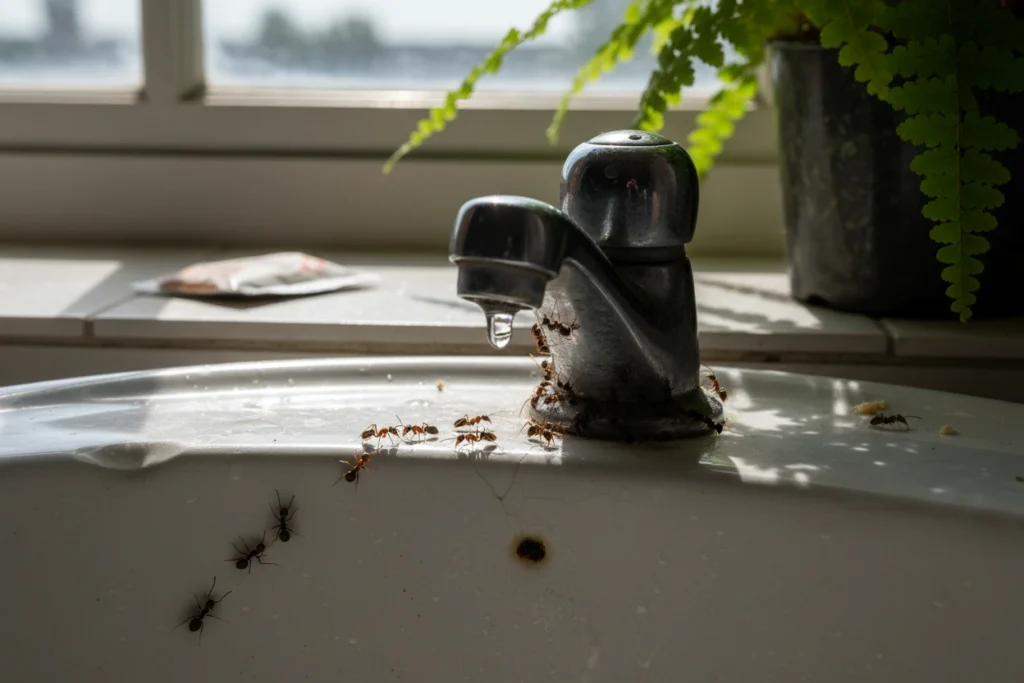
Bathroom ants aren’t trespassing — they’re responding to environmental signals your home is actively broadcasting. Moisture gradients, organic debris, and structural gaps are drawing species like Tapinoma sessile, Lasius niger, and Tetramorium caespitum directly to your bathroom. Their trails often indicate concealed leaks or water-damaged wood that you can’t yet see. Understanding what’s attracting them — and what they’re signaling — is the first step toward eliminating both the infestation and its underlying cause.
Key Takeaways
-
Ants in your bathroom are attracted to moisture, warmth, and organic debris like soap residue, hair, and toothpaste.
-
Different ant species signal specific problems; carpenter ants and moisture ants indicate water-damaged wood or hidden structural issues.
-
Ants can detect concealed leaks using specialized antennae sensors, making their trails useful diagnostic tools for hidden moisture.
-
Their presence often reveals entry points like cracked grout, gaps around plumbing, or deteriorating weatherstripping needing immediate attention.
-
Eliminating ants requires addressing root causes: repairing leaks, improving ventilation, sealing entry points, and consulting professional pest control if needed.
Why Ants Are Drawn to Your Bathroom
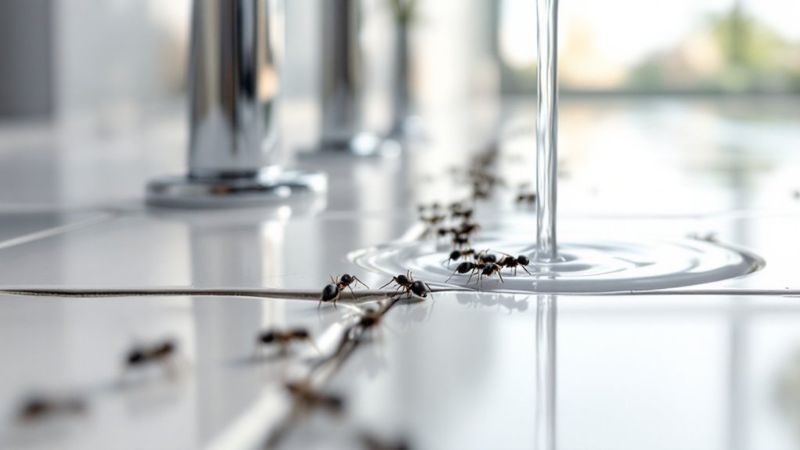
Bathrooms offer ants a reliable combination of resources that trigger foraging behavior: moisture, warmth, and organic debris.
Condensation on pipes, standing water near drains, and humidity from showers create ideal conditions for species like Tapinoma sessile (odorous house ants) and Lasius niger (black garden ants), both drawn to consistent moisture sources.
Attracting factors extend beyond water—soap residue, hair, skin cells, and toothpaste provide accessible carbohydrate and protein nutrients.
Poor bathroom cleanliness accelerates colonization by sustaining scout ants, which deposit pheromone trails that recruit additional foragers.
Cracks in grout, gaps around plumbing penetrations, and poorly sealed baseboards serve as primary entry points.
Understanding these biological drivers helps you identify what conditions in your bathroom are actively supporting ant activity. Additionally, allowing ants to establish colonies can lead to significant structural damage, making it essential to address infestations promptly.
Which Ants Are Most Common in Portland Bathrooms
You’ll less frequently encounter Tetramorium caespitum (pavement ants), though they do appear in ground-level bathrooms, exploiting concrete expansion joints and utility penetrations. Each species signals something distinct about your bathroom’s structural or moisture conditions. Accurate identification isn’t academic—it directly determines which remediation strategy will eliminate the infestation rather than merely displace it. Understanding ant species behaviors can help in choosing the most effective treatment.
What Bathroom Ants Are Telling You About Hidden Moisture
When ants appear in your bathroom, they’re functioning as biological indicators of moisture conditions invisible to you.
Carpenter ants and moisture ants, in particular, navigate toward water-damaged wood, leaking supply lines, and failing caulk seals with precision that often outpaces your own detection capabilities.
Identifying and correcting these damp conditions—beneath sinks, around toilet bases, and inside wall cavities—eliminates the resource attracting colonies and addresses the structural vulnerability simultaneously. Regular inspections can also help detect these issues early, ensuring that pest control strategies are applied effectively.
Ants Detect Hidden Leaks
Ants are remarkably sensitive hygrometers—capable of detecting moisture gradients that fall below human perception. Their hygroreceptors identify vapor differentials as subtle as 2–3% relative humidity, guiding foraging workers toward concealed water sources with precision.
When you observe trailing ants near baseboards, beneath cabinetry, or along grout lines, their pest behavior effectively functions as biological leak detection—signaling pipe seepage, condensation accumulation, or compromised caulking that your instruments haven’t yet registered.
Lasius niger, Camponotus spp., and Tapinoma sessile each demonstrate this hygrotactic orientation independently of food availability. Their presence frequently precedes visible water damage by weeks.
Rather than treating ants as the primary problem, treat their trail as diagnostic data. Identify the moisture source first—the structural integrity of your bathroom depends on it.
Moisture Attracts Ant Colonies
Bathroom moisture doesn’t just attract individual foragers—it triggers coordinated colony recruitment. When a scout detects a moisture source, it deposits pheromone trails back to the nest, signaling nestmates to mobilize.
This ant behavior is chemically precise: different pheromone compounds communicate distance, quantity, and urgency. You’re not witnessing random intrusion; you’re observing a structured biological response to environmental data.
Moisture detection in ants operates through hygroscopic sensilla on their antennae, allowing them to locate water gradients with remarkable accuracy.
If you’re seeing trails converging near your toilet base, sink drain, or tub caulking, the colony has already triangulated a consistent moisture source. That concentration of foragers indicates a persistent problem—not an isolated incident requiring only surface-level intervention.
Fixing Damp Problem Areas
Foraging trails aren’t just a nuisance—they’re diagnostic data. Worker ants follow pheromone routes toward moisture gradients, meaning their path maps directly onto your home’s dampness detection problem.
Trace the trail backward: it terminates at a water source you may not have identified yet.
Prioritize these corrective measures for effective moisture management:
-
Re-caulk deteriorating grout lines around tubs, showers, and sink bases
-
Replace worn wax rings beneath toilets allowing subfloor saturation
-
Repair dripping supply lines and drain connections under vanities
-
Improve exhaust fan ventilation to reduce ambient humidity below 50%
-
Inspect wall cavities adjacent to plumbing penetrations for condensation accumulation
Eliminating the moisture eliminates the attractant. Without a viable water source, ant colonies deprioritize your bathroom entirely.
Are Bathroom Ants a Sign of a Bigger Infestation?
Visible ants are your warning indicator, not the full population.
Effective pest prevention requires locating the parent colony—often nested within wall voids, subfloor cavities, or exterior soil.
Treating only surface activity leaves the reproductive core intact, guaranteeing reinfestation. Additionally, understanding ant behavior and species is crucial for effective treatment and prevention strategies.
What You Can Do to Get Rid of Bathroom Ants
To eliminate bathroom ants, you’ll need to address three core factors: moisture, access points, and the infestation itself.
Start by repairing leaking pipes, improving ventilation, and sealing cracks or gaps where ants enter. Additionally, implementing eco-friendly pest solutions can further deter ant activity in your bathroom.
If these measures fail to resolve the problem, you should contact a licensed pest control professional to identify the species and apply targeted treatments.
Eliminate Moisture Sources
Since ants enter bathrooms primarily in search of moisture, eliminating standing water and excess humidity is one of the most effective ways to discourage them.
Audit your bathroom for common moisture traps—leaking pipes, dripping faucets, and water pooling around the base of your toilet or sink. Repair leaks promptly and dry wet surfaces after each use.
Address humidity sources by running your exhaust fan during and after showers to reduce condensation. If your fan is inadequate, consider a dehumidifier.
Make sure your bathroom has proper ventilation to maintain lower ambient moisture levels.
These structural and behavioral modifications remove the primary environmental conditions that attract ant colonies.
Without reliable water access, your bathroom becomes a notably less viable foraging site for most ant species.
Seal Entry Points
Eliminating moisture reduces your bathroom’s appeal, but ants that have already located an entry point will continue exploiting it regardless of interior conditions.
Entry point prevention requires systematic inspection of gaps around plumbing penetrations, baseboards, window frames, and tile grout lines — the primary structural vulnerabilities ants exploit. Carpenter ants (Camponotus spp.) and odorous house ants (Tapinoma sessile) follow established pheromone trails through openings as narrow as 1mm.
Apply sealing techniques using silicone caulk around pipe penetrations and deteriorated grout, expanding foam for larger wall voids, and weatherstripping along door thresholds.
Inspect exterior foundation points where plumbing enters the structure. Without closing these access corridors, interior treatments remain temporarily effective at best — ants will locate and re-establish new routes into your bathroom.
Call a Professional
Professionals conduct structural inspections, locate satellite colonies, and apply regulated insect growth regulators or non-repellent residual compounds that disrupt colony development at the source.
This taxonomic precision eliminates guesswork and reduces reinfestation risk.
For long-term pest prevention, a licensed technician can also provide a site-specific management plan addressing the moisture conditions and structural vulnerabilities driving continued ant activity in your bathroom.
When to Call a Pest Control Professional
Pest prevention at the DIY level has limits. Over-the-counter baits often suppress surface activity without eliminating the queen or satellite colonies.
A licensed technician can conduct a precise taxonomic identification, locate harborage zones within wall voids or subfloor spaces, and deploy species-specific treatments.
Contact Pest Patrol if infestations persist beyond two weeks, if multiple ant species are present, or if structural moisture damage accompanies the activity.
Early professional assessment reduces long-term remediation costs considerably.
Frequently Asked Questions
Can Bathroom Ants Contaminate My Toothbrush or Other Personal Care Items?
Yes, ants can contaminate your toothbrush and personal care items by transferring bacteria and pathogens. You’ll want to prioritize toothbrush hygiene and implement pest prevention measures immediately to protect yourself from potential microbial cross-contamination risks.
Do Bathroom Ants Bite, and Are They Dangerous to My Family?
Most bathroom ants rarely bite unless threatened. Their ant behavior poses minimal danger to your family. You’ll reduce risk through bite prevention strategies—avoid disturbing colonies, seal entry points, and contact Pest Patrol for precise species identification and elimination.
How Long Does It Typically Take to Fully Eliminate a Bathroom Ant Problem?
With effective treatments, your ant elimination timeline typically spans one to four weeks. You’ll see worker numbers decline within days, but full colony eradication depends on species, infestation severity, and whether you’ve addressed the underlying moisture source.
Will Ants in My Bathroom Affect My Homeowner’s Insurance Claim?
Ant infestation impacts typically won’t support a homeowner’s insurance claim, as most insurance policy exclusions specifically cover pest-related damage. You’ll find insurers classify infestations as preventable maintenance issues, making professional extermination your financial responsibility.
Can I Use Essential Oils to Repel Ants From My Bathroom Naturally?
Yes, you can use natural repellents like essential oil blends containing peppermint, tea tree, or eucalyptus to deter ants. Apply them along entry points, but they won’t eliminate underlying infestations driving colonies into your bathroom.
Conclusion
Ants in your bathroom aren’t random — they’re biological indicators of specific structural and environmental conditions within your home. You’re seeing foraging workers responding to moisture gradients, microbial food sources, or established colony activity nearby. Address the root causes: eliminate moisture, seal entry points, and identify the species present. If you can’t resolve the infestation through exclusion and sanitation alone, you’ll need professional taxonomic identification and targeted treatment protocols to achieve lasting control.