
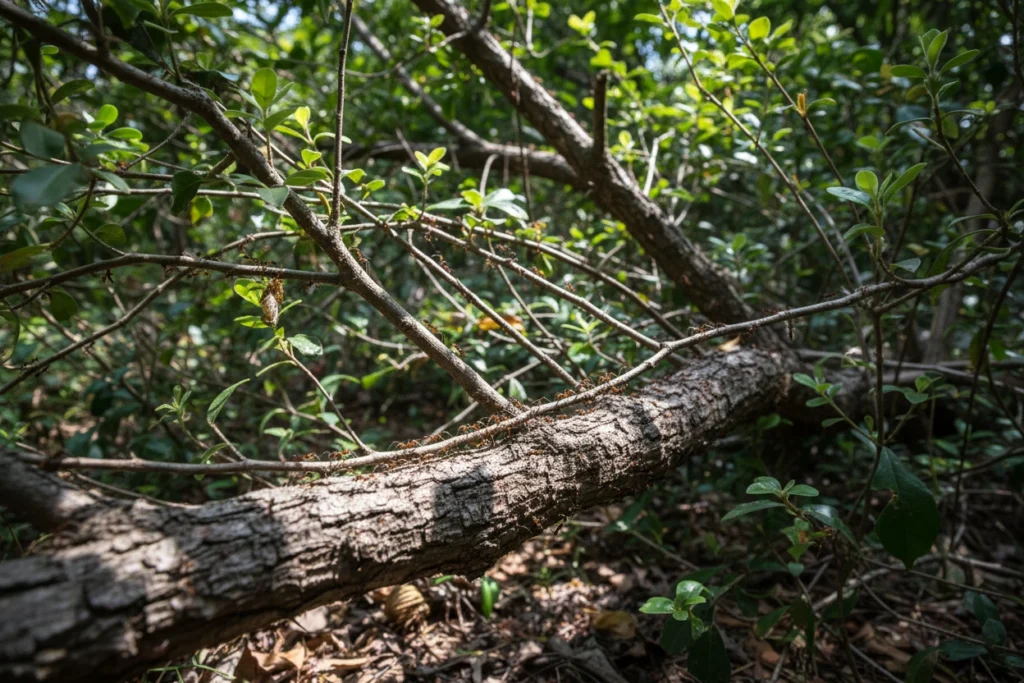
When tree branches or shrubs touch your home’s exterior, you’re fundamentally giving ants a direct runway past any ground-level barriers you’ve put in place. Scout ants deposit pheromone trails along these structural corridors, directing entire foraging columns toward warmth, moisture, and food odors inside. Aphid-hosting species like ornamental cherry and linden amplify this traffic by supplying honeydew along the route. The patterns ants leave behind reveal far more than most homeowners expect.
Key Takeaways
-
Tree branches touching exterior walls act as direct bridges, allowing ants to bypass ground-level barriers and access homes easily.
-
Dense shrubs like junipers create protected, hidden trail networks that shield foraging ants from predators and environmental exposure.
-
Aphid-hosting trees such as linden and ornamental cherry sustain continuous ant traffic through honeydew production along branches.
-
Scouts deposit pheromone trails on vegetation, directing colony members along established routes toward food and shelter.
-
Fruit-bearing trees provide direct sugar sources, encouraging repeated ant foraging along the same branch corridors over time.
Why Ants Use Tree Branches as Bridges Into Your Home
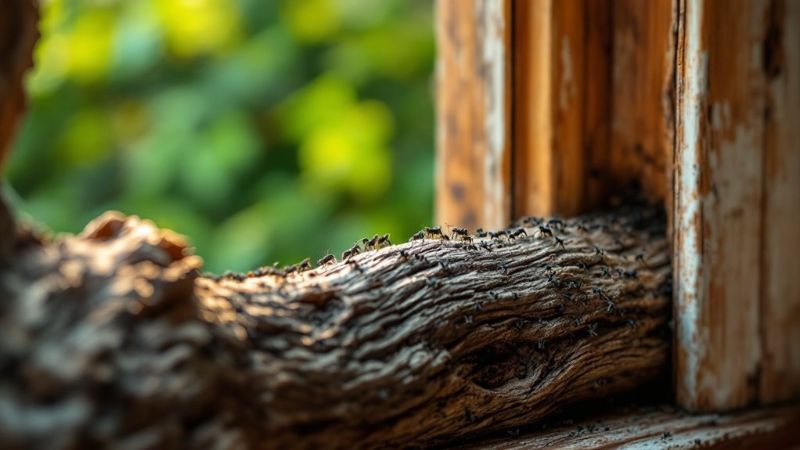
Ants are ground-dwelling insects by nature, but they’re opportunistic foragers that will exploit any continuous pathway leading to a food or shelter source. When tree branches or shrubs contact your home’s exterior, they form a structural corridor that ants treat as an extension of their foraging network.
This ant behavior is chemically driven — scouts deposit pheromone trails along viable routes, directing colony members toward detected resources. Your home’s warmth, moisture, and food odors make it a high-value target. Additionally, species like odorous house ants are particularly adept at navigating these pathways, making them common intruders in Portland homes.
Bridge construction isn’t intentional engineering on the ant’s part; it’s your landscaping doing the work for them. Species like carpenter ants and odorous house ants readily exploit these vegetative bridges, bypassing your foundation’s typical defensive barriers entirely and gaining direct access to wall voids, attics, and kitchens.
Which Trees and Shrubs Attract the Most Ant Traffic
Not all trees and shrubs carry equal ant traffic—certain species consistently function as primary conduits into structures.
If you have aphid-hosting trees like linden (Tilia spp.) or ornamental cherry (Prunus spp.) near your home, you’re likely sustaining ant foraging activity through honeydew production, while dense ground-cover shrubs such as junipers (Juniperus spp.) provide protected trail networks at soil level.
Fruit-bearing trees—apple (Malus spp.), pear (Pyrus spp.), and fig (Ficus carica)—compound the problem by offering both direct sugar sources and canopy contact points that ants exploit as structural entry routes. Additionally, maintaining kitchen cleanliness is crucial to deter these pests from entering your home.
Aphid-Producing Trees Attract Ants
While many factors draw ants toward trees and shrubs, few are as reliable as the presence of aphids. Aphids excrete honeydew, a sugar-rich waste product that ants actively harvest, creating a mutualistic relationship that intensifies ant foraging activity on infested plants.
Several species are particularly problematic. Roses (Rosa spp.), crape myrtles (Lagerstroemia spp.), and soft maples (Acer spp.) sustain heavy aphid populations, making them consistent ant magnets. Ornamental cherries and lindens (Tilia spp.) follow closely behind.
When you’re making landscaping decisions, tree selection directly influences your ant pressure. Choosing aphid-resistant cultivars reduces the food incentive that draws colonies upward into your canopy.
Integrating aphid management strategies—including beneficial insect conservation and targeted treatments—disrupts the honeydew supply and measurably reduces ant activity on your property.
Shrubs With Dense Ground Cover
You’ll often find foraging trails radiating outward from these shrubs toward structural entry points. When dense foliage contacts your home’s foundation, it eliminates the exposed ground buffer that naturally discourages ant movement.
Effective pest prevention requires trimming ground-covering shrubs at least 12 inches from your foundation and removing accumulated leaf litter beneath the canopy.
These modifications disrupt the sheltered corridors that facilitate colony expansion and reduce ant pressure on your structure considerably.
Fruit Trees Draw Ants
Fruit trees rank among the highest ant-attracting landscape features you can have near your home. Species like apple (Malus domestica), pear (Pyrus communis), and cherry (Prunus avium) produce sugary exudates, overripe fruit, and aphid colonies — all of which function as reliable foraging signals for carpenter ants (Camponotus spp.) and pavement ants (Tetramorium caespitum).
Fallen fruit fermenting on the soil surface intensifies recruitment pheromone activity, drawing exponentially larger foraging columns. Branches extending toward your roofline become direct structural bridges into your home.
Consistent fruit tree maintenance — including prompt removal of dropped fruit, pruning overhanging limbs, and managing aphid populations — directly supports ant prevention. Neglecting these tasks fundamentally sustains a permanent food-and-access corridor between your landscape and your living spaces.
How Ants Turn Outdoor Plants Into Indoor Infestations
Potted plants and garden beds near your home’s foundation often serve as staging grounds for ant colonies before they migrate indoors. Ant behavior follows predictable escalation patterns, making indoor infestations largely preventable once you recognize the progression:
-
Workers establish foraging trails from soil beds toward structural entry points.
-
Moisture retained in potted plant soil attracts nesting scouts.
-
Root systems and organic mulch provide thermal insulation for satellite colonies.
-
Trailing pheromones deposited along plant stems guide workers through foundation gaps.
You’ll notice these changes accelerate during dry summer months when outdoor food sources diminish.
Implementing sanitation practices can significantly reduce the likelihood of these pests making their way indoors.
Relocating potted plants at least 18 inches from your foundation and eliminating mulch contact with siding disrupts these colonization pathways before ants successfully breach interior spaces.
Signs That Shrubs Are Feeding an Ant Highway
Shrubs positioned against your home’s exterior often function as living infrastructure for ant foraging networks, particularly when their canopy contacts siding or their root zones retain consistent moisture.
Observing specific indicators sharpens pest identification and reveals active ant behavior patterns. Watch for these diagnostic signs:
-
Trailing columns moving vertically along stems between soil and structure
-
Aphid or scale colonies on foliage, which ants actively tend for honeydew
-
Soil disturbance at root crowns, indicating sub-surface galleries
-
Frass deposits or shed wings near branch-to-wall contact points
-
Smooth, worn pathways on bark where repeated traffic has removed surface texture
Each sign confirms that your shrub isn’t merely adjacent to an infestation—it’s actively sustaining one. Additionally, early detection of ant activity is crucial to prevent escalation and potential structural damage.
Trim and Position Plants to Cut Off Ant Access
Once you identify shrubs and trees acting as ant highways, trim branches so they don’t contact your home’s exterior, eliminating the physical bridge colonies use to transfer workers and foragers onto structural surfaces.
You should also evaluate where new plantings go, keeping woody shrubs and ground covers at least two feet from your foundation, since proximity directly correlates with ant access frequency.
Strategic repositioning of container plants, trellises, and climbing vines disrupts the spatial continuity ants rely on to extend their foraging networks toward interior entry points. Additionally, understanding ant foraging trails can help you determine which areas need the most attention when managing your landscape.
Trim Branches Away From Home
Branches and shrubs that make contact with your home’s exterior act as natural highways, giving ant colonies direct structural access without ever touching the ground.
Consistent branch maintenance disrupts these routes and remains one of the most effective forms of structural pest prevention.
Follow these trimming guidelines:
-
Maintain a minimum 18–24 inch clearance between all woody vegetation and your home’s siding, roofline, and foundation.
-
Inspect contact points seasonally, as branches grow incrementally and reestablish access between maintenance cycles.
-
Remove deadwood first, since decaying limbs harbor moisture and fungal material that attract Camponotus (carpenter ants) specifically.
-
Cut at the branch collar, promoting clean healing and eliminating jagged stub surfaces where ants establish initial foraging trails.
Strategic Plant Placement Matters
Controlling vertical access through branch trimming addresses one vector, but the horizontal plane presents its own set of vulnerabilities. Dense plantings positioned flush against your foundation create continuous vegetative corridors that foraging workers exploit systematically.
Strategic plant spacing disrupts these corridors, eliminating the structural connectivity that ant colonies depend on for efficient resource transport.
Maintain a minimum 12-inch clearance between shrubs, ornamentals, and your exterior walls. This gap functions as a pest barrier, forcing scouts into open ground where exposure increases predation risk and detection likelihood.
Ground-covering plants like ivy and pachysandra are particularly problematic—their dense canopy retains moisture and conceals tunneling activity directly against your structure. Repositioning or removing such species reduces harborage opportunities and eliminates the microhabitat conditions that support sustained colony establishment near your home.
When Landscaping Changes Aren’t Enough to Stop Ants
While landscaping modifications—trimming vegetation, relocating mulch, and eliminating moisture sources—can disrupt ant foraging routes, they don’t always resolve an established infestation.
Colonies operating beneath foundations or within wall voids remain unaffected by surface-level landscaping solutions. Observing persistent ant behavior after modifications indicates deeper structural colonization requiring targeted intervention:
-
Queen elimination — Worker removal without queen extermination allows colonies to regenerate rapidly.
-
Subterranean nesting — Underground galleries extend beyond landscaping correction reach.
-
Multiple satellite colonies — Lasius and Formica species establish decentralized networks resistant to perimeter disruption.
-
Chemical trail persistence — Pheromone pathways remain intact despite physical landscape alterations.
Pest Patrol’s technicians identify infestation origin points, delivering treatments that address colonies at their source rather than their surface activity.
Frequently Asked Questions
Can Ants Cause Actual Damage to Healthy Trees or Shrubs?
Most ants don’t directly damage healthy trees, but you’ll notice their ant behavior can worsen tree health by farming aphids, which excrete honeydew, attracting mold and weakening your shrubs over time.
Do Ant Highways Form Faster During Specific Portland Weather Conditions?
Yes, you’ll notice ant highways forming faster during Portland’s warm, dry spells. Temperature fluctuations trigger foraging surges, and specific weather patterns—particularly post-rain warming—accelerate trail establishment as colonies exploit newly accessible branch and shrub pathways.
Are Certain Ant Species More Likely to Invade Homes Than Others?
Yes, certain species exhibit heightened home invasion tendencies. You’ll observe that Lasius niger (black garden ants) and Linepithema humile (Argentine ants) demonstrate aggressive ant behavior, actively exploiting structural entry points in your Portland residence.
How Quickly Can a Small Ant Trail Grow Into a Full Infestation?
Once scouts locate food, ant behavior shifts rapidly—trail formation can explode from a few workers to thousands within 24–48 hours. You’ll notice pheromone recruitment accelerates geometrically, turning minor activity into a full infestation surprisingly fast.
Is Professional Trimming Required, or Can Homeowners Manage It Themselves?
You don’t need professional trimming; you can manage it yourself using basic homeowner tools. Apply precise trimming techniques to cut branches 18–24 inches from your structure, systematically eliminating Formicidae’s arboreal pathways before colony establishment accelerates.
Conclusion
When Lasius, Camponotus, and Formica species establish foraging trails along arboreal contact points, your home becomes an extension of their foraging territory. You’ve seen how branch-to-structure interfaces function as elevated corridors that circumvent ground-level deterrents. By maintaining verified clearance distances and observing trail patterns systematically, you’re disrupting the behavioral pathways these species depend on. Don’t underestimate consistent structural separation — it’s your most measurable variable in limiting interior colonization events.