
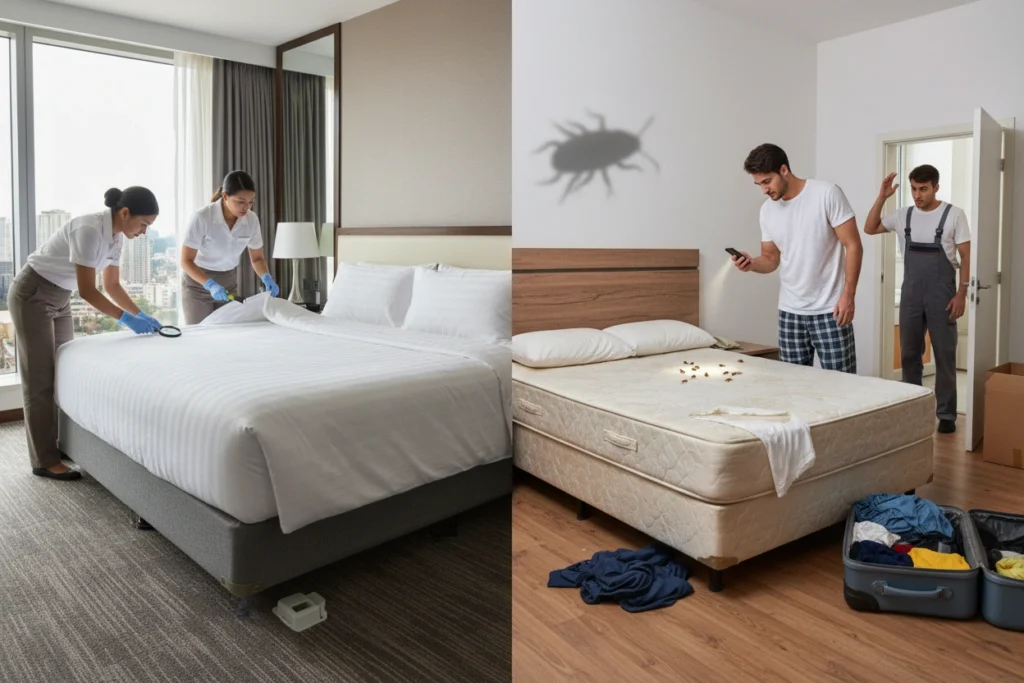
Managing bed bugs in a hotel or motel demands faster, more aggressive protocols than apartment management. You’re resetting infestation risk with every checkout, which means inspections can’t wait for tenant complaints — they must happen systematically after every room turnover. Treatment windows are tighter, liability exposure is more immediate, and standard commercial policies often won’t cover you. The differences between hospitality and residential protocols go deeper than most property operators expect.
Key Takeaways
-
Hotels require inspections after every guest checkout, while apartments follow longer cycles based on tenant-reported activity.
-
High guest turnover in hotels creates multiple infestation entry points, increasing bed bug risk compared to apartments.
-
Treatment in occupied hotels is complicated by guest schedules, while landlords have more procedural latitude with tenants.
-
Hotels face immediate liability upon guest complaints, whereas landlords operate under state-specific habitability frameworks with more response time.
-
Post-treatment monitoring is harder in hotels due to frequent room turnover disrupting inspection continuity and treatment effectiveness.
Why Hotels Face Higher Bed Bug Risk Than Apartments

Because hotels cycle through dozens—sometimes hundreds—of guests per week, they face a structurally higher bed bug risk than apartment buildings where occupancy remains relatively stable.
You’re dealing with an environment where guest demographics shift constantly—international travelers, business professionals, families—each arriving from different cities, countries, and accommodations with varying pest control standards. That diversity of origin creates repeated introduction points that apartments simply don’t experience.
Compounding this risk, cleaning protocols between checkouts prioritize speed over inspection depth. Housekeeping staff turn rooms quickly, often within 30 to 60 minutes, leaving insufficient time to thoroughly assess mattress seams, headboards, and upholstered furniture.
Unlike apartment managers who monitor long-term tenants, hotel operators must account for infestation risk resetting with every new guest. Furthermore, the use of eco-friendly practices in pest control is not always prioritized in the hospitality industry, leaving properties vulnerable to infestations.
How Guest Turnover Changes Bed Bug Detection
Detection windows shrink considerably when occupancy cycles reset every one to three days.
Guest behavior directly disrupts physical evidence — disturbed linens, repositioned luggage racks, and laundered bedding remove early-stage indicators before housekeeping staff can document them.
You’re fundamentally restarting the detection clock with every checkout.
Turnover impact compounds the problem structurally.
A single infested guest introduces eggs that won’t hatch for six to ten days, meaning subsequent guests occupy the room during the incubation period.
By the time live activity appears, two or three additional guest cycles have already passed through.
To counter this, your housekeeping team needs a standardized inspection protocol executed at every turnover — not just weekly or on complaint.
Consistent documentation across room cycles is the only method that reliably catches early-stage activity.
Additionally, implementing early detection methods can help identify infestations before they escalate.
Hotel Inspection Protocols vs. Apartment Inspections
When you manage a hotel, you’re inspecting rooms after every checkout cycle—a frequency that far exceeds the periodic walkthroughs typical of apartment inspections. Your room-by-room protocol must cover the mattress seams, box spring, headboard, nightstand, and upholstered furniture in a systematic sequence, leaving no harborage point unchecked. Evidence of multiple sightings and consistent signs like droppings can indicate a wider infestation, making thorough inspections crucial in hospitality settings.
Apartment inspections, by contrast, follow a longer scheduling cycle and focus on shared wall voids, baseboards, and tenant-reported activity rather than the high-turnover touchpoints that define hotel environments.
Inspection Frequency Differences
Hotels and motels require a fundamentally different inspection cadence than apartment complexes due to the constant turnover of occupants.
In hospitality settings, you’re dealing with new guests every one to three nights, which demands inspection schedules tied directly to room turnover rather than fixed quarterly or annual cycles. Housekeeping staff must inspect each room between every checkout and check-in, logging findings to support accurate pest tracking across the property.
Apartment complexes, by contrast, typically schedule inspections during lease renewals or upon tenant complaints. Residents remain in place for months or years, creating more predictable risk windows.
Hotels don’t have that advantage. Without consistent room-by-room documentation after each occupancy cycle, infestations spread rapidly before detection, making structured daily inspection protocols non-negotiable for effective bed bug management.
Room-By-Room Protocols
Inspection frequency sets the foundation, but the room-by-room protocols that follow each checkout are where bed bug management either holds or fails.
In hotels, you’re executing standardized inspections tied directly to cleaning protocols — every room layout gets the same systematic sweep: mattress seams, box springs, headboards, nightstands, upholstered furniture, and baseboards.
Housekeeping staff must complete visual checks before fresh linens go on.
Apartment inspections don’t follow that rhythm. You’re responding to tenant reports rather than executing post-checkout protocols, and each unit’s room layout varies considerably.
Furniture placement, clutter levels, and tenant cooperation all affect your thoroughness.
Hotels build inspection into the turnover workflow automatically. Apartments require scheduling, access coordination, and often repeated visits — making early detection far more difficult to standardize.
Treatment Challenges in Occupied Hospitality Properties
Treating bed bugs in occupied hospitality properties introduces operational constraints that don’t exist in residential settings.
You’re coordinating treatment windows around check-in and check-out schedules, limiting your chemical exposure time and follow-up access. Guest behavior compounds the problem — luggage repositioning, housekeeping interruptions, and unreported sightings delay your response timeline and compromise treatment continuity.
Maintenance issues create additional obstacles.
Structural gaps behind headboards, aging baseboards, and worn upholstery seams give bed bugs protected harborage that standard spray applications can’t fully penetrate. You’ll need heat treatment or targeted crack-and-crevice applications to address these harborage zones effectively. Furthermore, bed bugs reproduce rapidly, complicating the timeline for effective treatment.
Room turnover also prevents adequate post-treatment monitoring.
Without controlled re-entry protocols, you can’t confirm treatment success before the next guest occupies the room, increasing reinfestation risk.
Legal and Liability Differences for Hotels vs. Landlords
When you manage a hotel or motel, you face immediate, strict liability exposure the moment a guest reports bed bugs. This is because courts typically treat infested rooms as a breach of the implied warranty of habitability owed to transient occupants.
Landlords, by contrast, operate under state-specific statutory frameworks that define notice requirements, remediation timelines, and tenant remedies before liability attaches.
You must understand these distinctions clearly, because a hotel’s failure to act within hours carries far greater legal risk than a landlord’s failure to act within days.
Hotel Liability Exposure
Hotels face a fundamentally different liability landscape than landlords when it comes to bed bug infestations. As a hotel operator, you’re exposed to immediate tort liability the moment a guest documents evidence of bed bugs in an occupied room.
Unlike landlords, you can’t rely on lease agreements or notice-and-cure provisions to limit your exposure window.
Your insurance coverage must specifically address pest-related guest injury claims, property damage, and medical expenses. Standard commercial property policies often exclude these scenarios, leaving significant gaps.
Liability waivers offer minimal protection in bed bug cases because courts consistently view them as unenforceable against health and safety violations.
You’re also vulnerable to reputational damage claims, which standard policies rarely cover.
Addressing infestations proactively is your strongest liability mitigation strategy.
Landlord Legal Obligations
Landlords operate under a distinct legal framework that gives you more procedural runway than hotel operators, but it doesn’t eliminate your liability exposure.
Oregon’s habitability statutes require you to maintain rentals free of pest infestations, and tenant rights provisions mandate timely remediation once you receive written notice. You must document every complaint, inspection, and treatment in your property records.
Pest disclosure obligations vary by jurisdiction, but failing to disclose a known infestation before signing a lease creates significant legal exposure.
Unlike hotels, you can issue notice-to-enter before scheduling pest control access, which gives you coordination flexibility. However, delays in treatment still violate habitability standards, regardless of your procedural compliance.
Maintain a licensed pest control contract and retain all service records as evidentiary protection.
What to Do If Your Property Has a Bed Bug Problem
If your property has a confirmed or suspected bed bug infestation, act immediately—delays allow populations to spread to adjacent rooms and units.
Begin with professional bed bug identification to confirm the species and assess infestation scope. Document all affected areas, isolate impacted rooms, and notify guests or tenants per applicable legal requirements.
Coordinate with a licensed pest control professional to develop targeted pest control strategies, which may include heat treatment, chemical application, or an integrated approach depending on infestation severity.
Inspect adjacent rooms as a precaution—bed bugs migrate through wall voids and shared plumbing. Understanding bed bug dynamics is crucial for effective problem resolution.
Establish a follow-up inspection schedule to verify treatment success.
Maintain detailed records of all findings, treatments, and communications to support compliance and protect against liability.
Frequently Asked Questions
Can Bed Bugs Spread Through Shared Laundry Facilities in Hotels?
Yes, bed bugs can spread through shared laundry facilities. You’ll minimize risk by following strict laundry procedures—transport items in sealed bags and maintain guest awareness by inspecting machines before use to prevent cross-contamination.
Do Bed Bug-Sniffing Dogs Work Better in Hotels Than Apartments?
Yes, you’ll find canine accuracy in bed bug detection is higher in hotels due to standardized room layouts. Dogs can systematically sweep identical units faster, making the protocol more efficient than traversing varied apartment configurations.
How Long Should a Hotel Room Stay Vacant After Bed Bug Treatment?
You’ll want to keep the room vacant for at least 4 hours after chemical treatment, though heat treatments allow faster reoccupancy. Vacancy duration directly impacts treatment effectiveness, so you shouldn’t rush the process.
Are Certain Hotel Room Types More Prone to Bed Bug Infestations?
Yes, certain room types are higher bed bug hotspots. You’ll find infestations concentrated in ground-floor rooms, high-turnover suites, and connecting rooms where room layout creates more entry points and harboring opportunities for spreading pests.
Can Hotel Loyalty Program Members Request Bed Bug Inspection History?
You can submit guest inquiries requesting inspection transparency, but hotels aren’t legally obligated to disclose records. Check your loyalty program’s member services portal, escalate to management, or review third-party pest inspection databases for documented infestation histories.
Conclusion
When you manage a hospitality property, you can’t afford to treat bed bugs like a residential inconvenience. You’re operating under tighter timelines, higher liability exposure, and constant guest turnover that accelerates infestation spread. You’ll need systematic inspection protocols, rapid-response treatment procedures, and documented compliance records working together. Implement your detection, treatment, and prevention layers as integrated systems rather than isolated reactions. Your property’s reputation—and your guests’ safety—depends on how precisely you execute these protocols every single day.